



Intel Nova Lake Chips May Unify AVX-512 Across E-Cores And P-Cores


While the groundwork for this was technically laid back in November when Intel released GCC patches (following our earlier reporting), a major new piece of the puzzle has just surfaced. Those patches revealed that Nova Lake would have not only AVX-512, but in fact the latest AVX10.2 version of it, as well as APX and MOVRS. But now, according to notorious Intel leaker Jaykihn, that information definitely applies to both P-core and E-core architectures, which is great news, as it means that developers will actually be able to use the new instructions on the consumer chips.
Let's back up a bit. Intel CPUs use the x86 instruction set, named after the 1978 Intel 8086 processor from which it was originally derived. This instruction set has seen dozens of 'Instruction Set Extensions' from both Intel and AMD over the decades, and the two have an extensive and deep cross-licensing agreement for them. One of the most contentious of these extensions was AVX-512, which extends the Advanced Vector Extensions to support 512-bit vectors. Only, this is actually a very confusing name because AVX-512 encompasses a lot of instructions that actually have nothing to do with 512-bit vectors. Even worse, which specific blocks of instructions are supported on a particular processor isn't necessarily intuitive, making AVX-512 as a feature very badly fragmented.
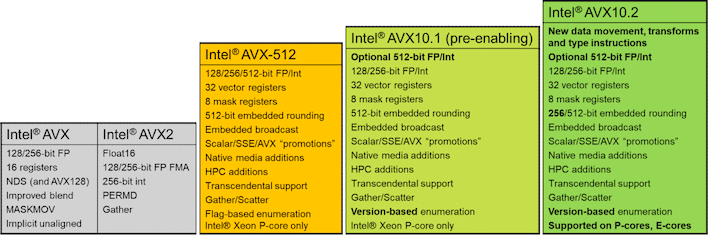
In 2023 Intel announced a new initiative to clean up the AVX-512 mess and give it a new name that is a bit less misleading. Thus, AVX10 was born. We wrote about AVX10 back when it was announced, so we won't go over it again, but the most important part is that it's moving from flag-based enumeration to version-based enumeration, meaning that there will be radically less confusion going forward about what instructions are actually supported on a given chip.
Now, despite being introduced way back in 2016, and showing up in several generations of Intel desktop and laptop CPUs AVX-512 hasn't actually been supported on Intel client processors since the 11th-gen Core Rocket Lake CPUs. There are a few reasons for this, but the biggest one is because all of those processors have been hybrid CPUs, and Intel's E-core architectures to date have not supported AVX-512 in any capacity. Windows doesn't have a mechanism to check code in flight and move it over to another CPU if the current core can't run it, so Intel just disabled the entire instruction set extension. A crude solution, but arguably the correct one considering that there was extremely little software that supported it at the time.

Heading into 2027, though, with the launch of the Nova Lake CPUs, that software situation has radically changed. Besides its broad use in scientific computing, major and critical application packages like ffmpeg have started to make use of AVX-512, and it's even finding use in gaming too. Of course, the biggest driver is AI. The AVX10 instruction set extension includes instruction blocks like AVX-VNNI, which can offer enormous speedups to AI workloads running on CPUs. The difference is so big Intel literally gave it a marketing name: Intel DLBoost.
Not only is Nova Lake finally bringing AVX-512 support via AVX10.2 to the Intel-using masses (as AMD has had AVX-512 support since Ryzen 7000), but it's also reportedly going to have native 512-bit execution, meaning that Nova Lake CPUs will come with full-fat AVX-512 vector execution units, something that most people didn't anticipate. The AVX10.2 standard only mandates 256-bit execution; support for 512-bit width is actually optional. However, the latest reports do indicate that Nova Lake will indeed get the same level of AVX support as AMD's Zen 5 processors, so that's encouraging for competition's sake.
There are all kinds of reasons to be excited about Nova Lake: massive core counts, big IPC uplifts, optional huge caches, and an Intel platform that's reportedly going to last more than one CPU upgrade. Check out our previous coverage for all those details. These chips are expected to launch very late this year, or more likely, early next year.





