



52-Core Intel Nova Lake CPUs Could Draw Up to 474 Watts Before Manual OC


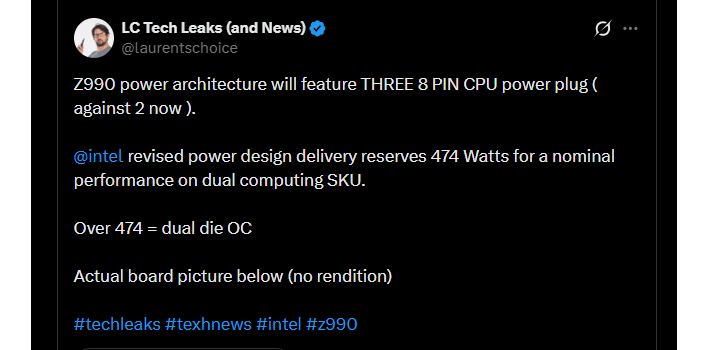
That information comes from this tweet by Laurent's Choice, which is known as "LC Tech Leaks (And News)" on X/Twitter. He specifically remarks that Intel's guidance for motherboard makers is "474 watts for a nominal performance on dual computing SKU". We take to mean that Intel's PL2, or the short-term turbo power limit, is 474W on Nova Lake processors with dual compute tiles.

We're willing to make that assumption because Jaykihn, who is a well-known and well-informed leaker of Intel products specifically, replied to LC Tech's tweet with the message above, indicating that the value was the "newest dual compute tile PL2 figure." So that's that.
What does that mean? PL2 is the short-term boost power limit on an Intel CPU; it defines the maximum short-duration power that a processor can draw, and it can only hit that power draw for a short period before falling back to PL1, which is the sustained power limit. As such, while you're likely to see in excess of 400 watts used by the top-end Nova Lake CPUs, it's not the 'usual' or 'normal' state of those chips.

The primary purpose of the tweet was to share the image above, which we've helpfully rotated to make it easier to understand. He remarks that the pictured pre-production board is an Intel Nova Lake motherboard, and comments on the fact that it will come with three power connectors. He seems to believe that it will be three EPS12V connectors, and that Intel is revising its guidance to board manufacturers to make it so, but the photo clearly shows a motherboard designed for two EPS12V and one 8-pin peripheral power plug.
This is interesting, but we've actually already seen what appears to be a complete board with this configuration when BenchLife got to sneak some photos of a pre-release Nova Lake motherboard back at Computex. That motherboard indeed had two EPS12V connectors and a third 8-pin connector, which was clearly keyed for 8-pin peripheral power.
EPS12V is designed to carry over 300 watts, so two of them already gets you to more than 600W, plus whatever you can siphon off the 24-pin ATX connector. An extra 8-pin peripheral power connector would add another 150W of headroom for that supposed 700W load that the chip can draw.
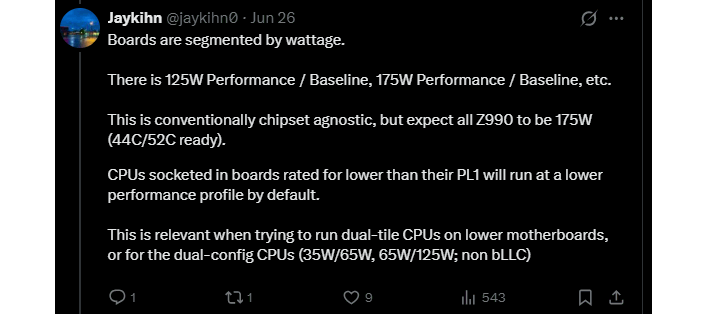
In response to a question about whether the third power connector was required either for dual-tile chips or for a higher power state on dual-tile chips, Jaykihn explained carefully that Intel motherboards are segmented by the wattage they can support. According to the leaker, boards are currently planned for 35W, 65W, 125W, and 175W CPUs, suggesting that these will be the PL1 values of the Nova Lake processors.
He goes on to say that the third power connector is a "nice to have" feature that will show up on high-end enthusiast boards, but that it is not required for dual-tile chips, not even for overclocking. He also notes that, in practice, all Z990 boards will likely be in the 175W performance segment, so if you're keen on a 52-core CPU, there's your motherboard chipset selection guidance.
The Nova Lake CPUs are now expected by most enthusiasts to launch very early next year, possibly at CES. Intel might do a paper launch very late this year, but it's looking like silicon on shelves will be Q1 next year at the earliest. No clue on how much these chips or boards are going to cost, though... nor the high-octane DDR5 memory that will be required to get the most performance out of them.





