AMD A6-3650 Llano APU Performance Review

A few weeks back, AMD officially launched their Llano-based A-Series Accelerated Processing Units, or APUs, in both desktop and mobile flavors. At the time, we covered the high-end variants of both A-Series offerings; our coverage of the desktop version A8-3850 APU and its companion chipsets is posted here and the mobile A8-3500M is detailed here. If you’re unfamiliar with Llano, we suggest perusing those two articles as they go into much more detail than we will in this piece.
We won’t rehash many of the architectural details, but just for a quick refresher, Llano is AMD’s mainstream, low-power APU that fuses four x86 cores with a DX11-class graphics processor on a single piece of silicon. The current flagship APU in the desktop line-up is the A8-3850, which hums along at 2.9GHz, with 400 active Radeon cores, that operate at 600MHz. The A6-3650 we’ll be showing you here is built using the same piece of silicon, but this lower-end A6-series part clocks in at 2.6GHz, with 320 active Radeon cores, running at 443MHz. Disregarding its operating frequencies and GPU configuration, current A6 and A8 series APUs are essentially identical, as is evidenced by the specifications below...

 |
|
| Tech / Package | 32nm / FM1 905-pin lidded μPGA, 40x40 mm, 1.27 mm pitch |
| TDP Configurations | 65W and 100W configurations |
| Processor Core | “Stars” 32nm HKMG process core (up to 4 cores), 128 KB L1 Cache(64 KB Instruction, 64 KB Data) 1 MB L2/Core, 128-bit FPUs |
| Memory | Up to DDR3 1866 |
| Graphics Core | Up to 400 Radeon Cores, DirectX 11 capable, UVD3 |
| Displays | Digital Display I/F DP0: Display Port, HDMI, DVI Digital Display I/F DP1: Display Port, HDMI, DVI |
| Graphics Features | AMD Dual Graphics Blu-ray 3D AMD Steady Video AMD Perfect Picture DisplayPort 1.1a, HDMI 1.4a |
| Power Management | Multiple low-power states 32-nm process for decreased power consumption PCIe core power gating PCIe speed power policy GPU power gating of Radeon Cores and video decode (UVD3) AMD Turbo Core technology on select models |
Although there will undoubtedly be more Llano-based APUs released in the future, the initial line-up is as follows:
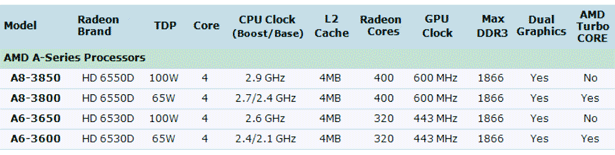
As we’ve mentioned the A8-3850 sits at the top of the stack, followed by the A8-3800. The A6-3650 we’ll be featuring here is the top-of-the-line A6-series part. And the A6-3600 is the entry level chip. These APUs differ in their frequencies and GPU configuration, their TDPs, and in their support for AMD’s Turbo Core technology. The parts with “50” in the model numbers run at full bore, while the standard parts use Turbo Core to temporarily boost operating frequencies to increase performance only when the workload demands it. The use of Turbo Core and their lower clocks result in the non-"50" part's lower average TDP.
We should point out, however, that at this time it is only the A8-3850 and A6-3650 that are available at retail. The other members of the A-Series have yet to ship.