


Items tagged with Sun
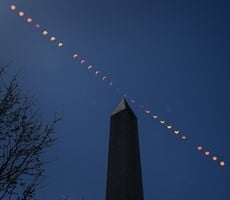
While the 2024 total solar eclipse has come and gone, NASA wants everyone to know there are plenty more eclipses on the horizon ahead of the next total solar eclipse in North America in August 2044. Over the next two years, folks willing...
Read more...

With the day of the total solar eclipse finally upon us, many may be wondering what time they need to head outside to view the celestial event. So, if you are in Mexico, or all the way up at the Island of Newfoundland, be sure to know...
Read more...
Millions of people across North America are preparing to view the upcoming total solar eclipse on April 8, 2024. NASA is also preparing to host a media briefing with other government agencies to discuss what scientific experiments the...
Read more...

On April 8, 2024, a total solar eclipse will darken parts of North America. For those wishing to view the celestial event with their own eyes, it is important to understand what makes a pair of solar eclipse glasses safe for staring at the...
Read more...

As people prepare to view the upcoming solar eclipse, hotels are preparing to make more money off those wanting to stay near the spectacle. New reports indicate hotels along the “zone of totality” are looking to cash in on people’s desire...
Read more...
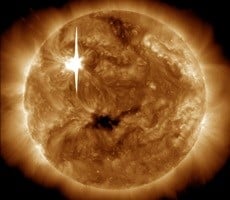
NASA’s Solar Dynamic Observatory, or SDO, detected three strong solar flares with the potential to disrupt radio communications, electric power grids, navigation signals, and could even pose a risk to spacecraft and astronauts. The first...
Read more...
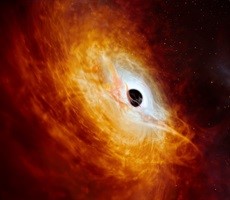
Astronomers using the Very Large Telescope (VLT) have detected an extremely bright quasar that is being powered by a supermassive black hole with an insatiable appetite for destruction. The supermassive black is believed to be growing in...
Read more...

This year’s total solar eclipse will not only last longer than the one in 2017, but will also be viewable in its totality by more people. 2024’s total solar eclipse will be viewable by an estimated 31.6 million people, while the one in...
Read more...
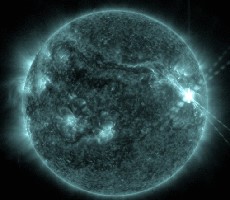
NASA was able to capture a striking image of a massive solar flare being emitted from the Sun on Thursday, which was so powerful that it caused a radio blackout in parts of the Americas. The flare, classified as an X2.8 flare, is the most...
Read more...
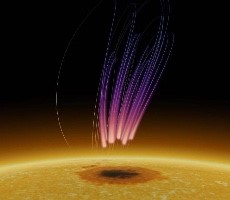
Astronomers were recently amazed to find an aurora-like display some 40,000 kilometers above a sunspot. Researchers from the New Jersey Institute of Technology's Center for Solar-Terrestrial Research (NJIT-CSTR) detailed radio observations...
Read more...
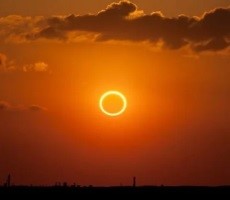
The sky over North, Central, and South America will feature a celestial delight later today, as an annular solar eclipse creates a "ring of fire." An annular solar eclipse differs from a total eclipse in that the moon is at the farthest...
Read more...
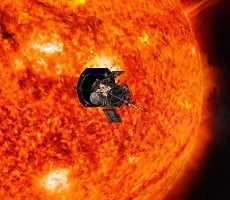
Last year, NASA's Parker Solar Probe flew through one of the most powerful coronal mass ejections (CMEs) ever recorded. The spacecraft's excursion through the CME gave scientists a new perspective on a 20-year-old theory about the...
Read more...
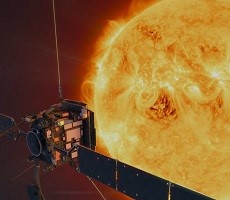
NASA's Parker Solar Probe and the European Space Agency's (ESA) Solar Orbiter performed incredibly hot spacecraft gymnastics to help solve a cosmic mystery about the Sun. The Sun's atmosphere, known as its corona, has a temperature of...
Read more...

An international collaboration of scientists has discovered the highest-energy light ever observed from the sun. These gamma rays also much brighter than scientists previously thought.
Humankind has been trying to figure out the bright...
Read more...

A duo of coronal mass ejections (CMEs) is projected to combine into one "cannibal" CME before impacting Earth later today. The combo could potentially cause a very strong geomagnetic storm here on Earth.
NASA describes a CME as a...
Read more...

The aurora borealis, typically only seen by those in far north locations like Alaska, Canada, and Scandinavia, is projected to be viewable in up to 17 US states, including New York and others along the East Coast on July 13, 2023.
The...
Read more...
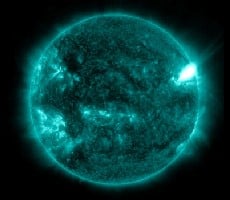
NASA's Solar Dynamic Observatory (SDO) captured a stunning image of an X1.0 solar flare. The event took place on July 2, 2023, and caused a temporary degradation or complete loss of High-Frequency radio signals in some parts of the...
Read more...

A new study concerning data collected by NASA's Parker Solar Probe (PSP) says that understanding how and where solar wind originates will aid in predicting solar storms that could potentially have devastating effects on satellites, the...
Read more...
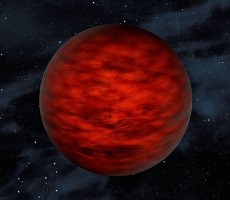
A team of astronomers has detected a brown dwarf with a scorching daytime temperature of 8,000 Kelvin (13,940 degrees Fahrenheit). This means this extremely hot object is hotter than our very own Sun, which has temps averaging around 5,500...
Read more...

An international team of astronomers has discovered the second-ever multiplanetary circumbinary system, giving Star Wars fans more hope that one day they might be able to travel to a Tatooine-like planet. The newly found planet, BEBOP-1c...
Read more...
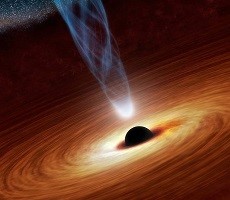
A pair of supermassive black holes, known as a binary black hole system, emitted a flare that is brighter than a trillion stars. The duo is located in galaxy OJ287 and are so close together they appear as one dot in the night...
Read more...

The world's most powerful ground-based solar telescope captured new close-up images of the Sun that are scorching hot. The National Science Foundation's (NSF) Daniel K. Inouye Solar Telescope's images highlight an assortment of sunspots...
Read more...