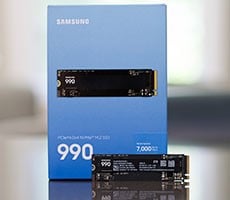
Samsung 990 SSD Review: A Low-Power, Mainstream QLC SSD In The AI Era


HDTune Benchmarks

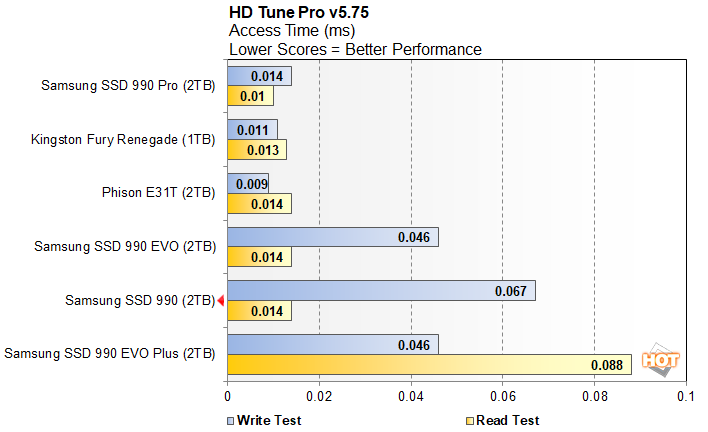
The Samsung 990 didn't play well with all of HD Tach's workloads. Transfer speeds looked good, and were actually competitive with the higher-end 990 Pro, but latency was much higher than expected in the write test. A similar thing happened with the 990 EVO Plus, but it was affected more so in the read test.
CrystalDiskMark x64 Benchmarks
CrystalDiskMark is a synthetic benchmark that tests both sequential and random small and mid-sized file transfers using incompressible data. It provides a quick look at best and worst case scenarios with regard to SSD performance, best case being larger sequential transfers and worse case being small, random transfers.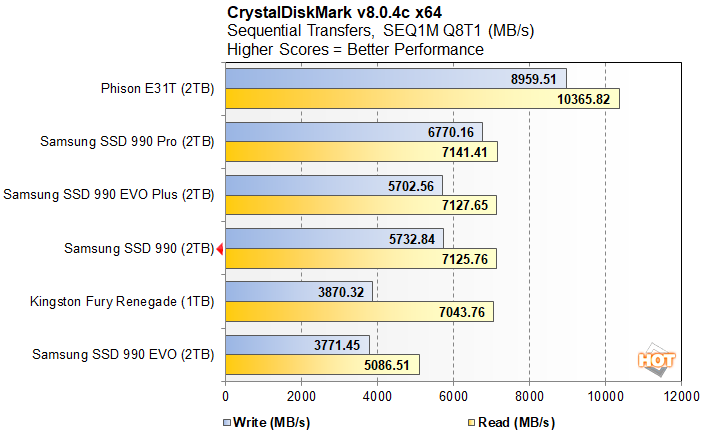
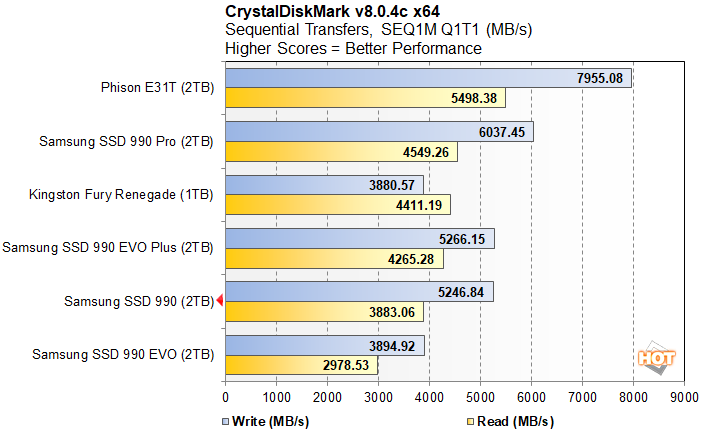
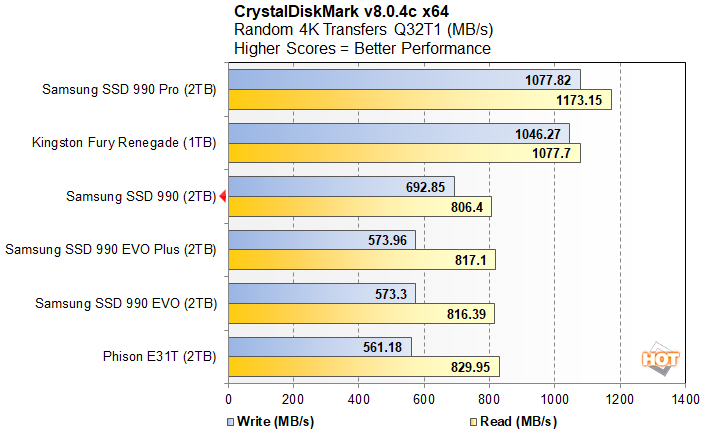
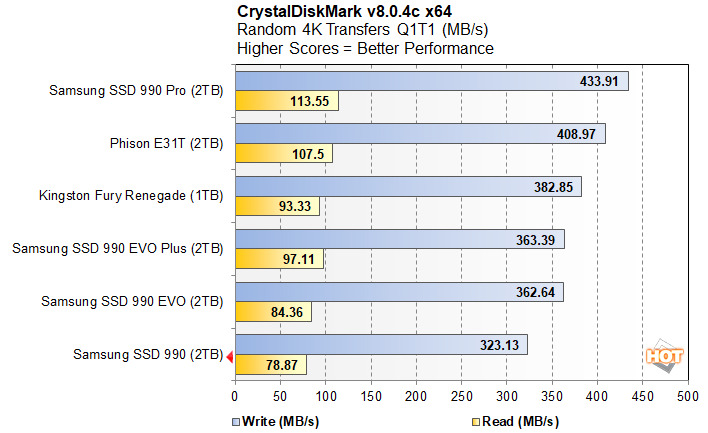
Random transfers looked decent the Samsung 990 at the higher queue depth, where the drive offered up the third best write speed. At QD1, however, the Samsung 990 trailed the packed overall in both the read and write tests.
Final Fantasy XIV: Endwalker Game Level Load Times
We also tested game level load times using the Final Fantasy XIV: Endwalker benchmark. This tool loads an array of different game levels during its graphics benchmark and outputs the average result when complete.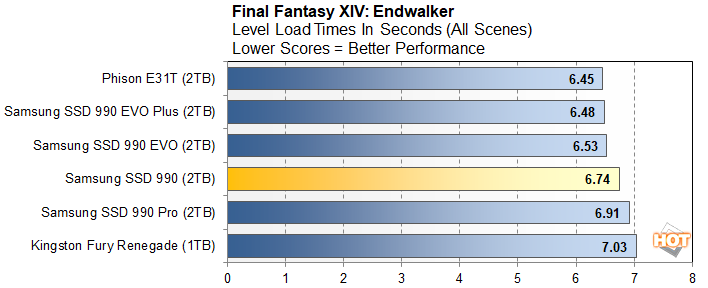
Level load times in Final Fantasy XIV: Endwalker were tightly grouped, but the Samsung 990 performed well all things considered. It was less than three-tenths of a second off the mark of the fastest drive here, and finished right in the mix with the other Samsung drives.
UL's 3DMark Gaming Storage Benchmark
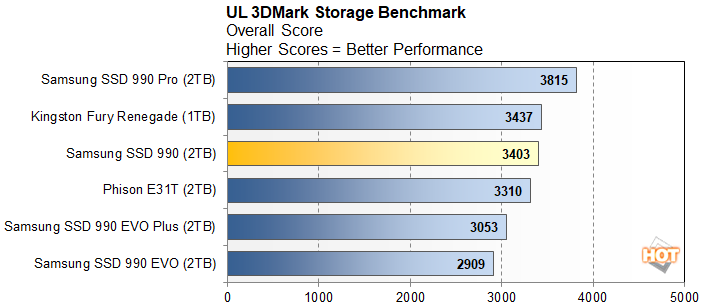
UL recently added a gaming-centric storage benchmark to 3DMark that leverages trace-based tests of actual PC games and gaming-related activities (such as streaming with OBS) to measure real-world gaming performance in a variety of scenarios. The tests include things like loading Battlefield V, Call of Duty: Black Ops 4, and Overwatch from the initial launch to the main menu, recording a 1080p gameplay video at 60 FPS with OBS while playing Overwatch, installing The Outer Worlds and saving game progress. And finally, copying the Steam folder for Counter-Strike: Global Offensive from one drive to another.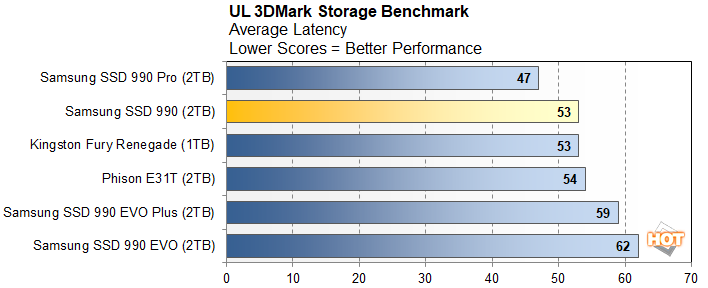
UL's PCMark 10 System Drive Storage Test
We like PCMark 10's new quick storage benchmark module for its real-world application measurement approach to testing. PCMark offers a trace-based measurement of system response times and bandwidth under various scripted workloads of traditional client / desktop system use cases.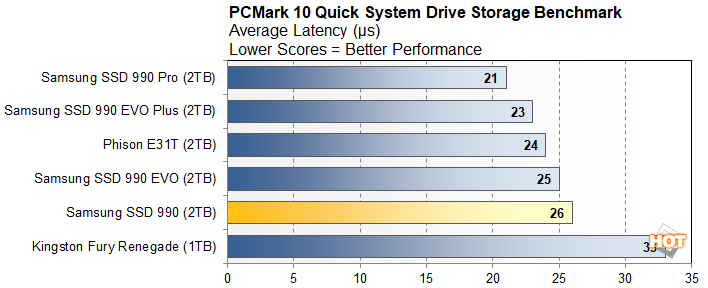
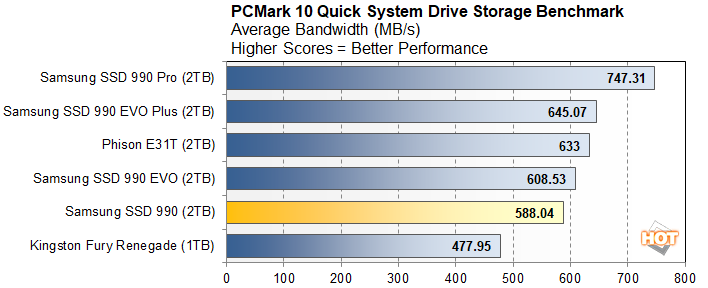
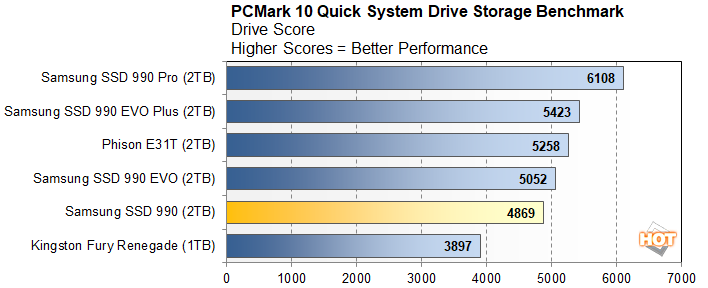
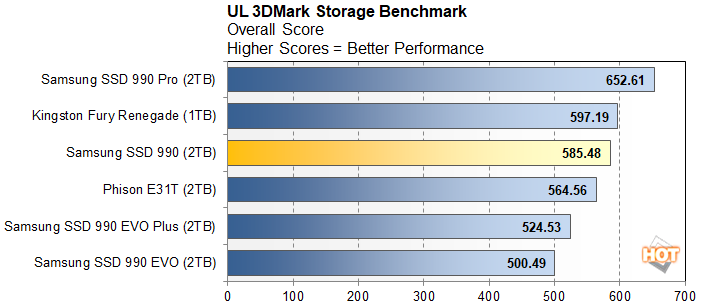
In PCMark's trace-based tests, the Samsung 990 was competitive with the 990 EVO, but ultimately trailed its siblings and outpaced only the Kingston Fury. The Samsung SSD 990 Pro led the pack by a wide margin here.
Samsung 990 SSD: Our Verdict
As we previously mentioned, the Samsung 990 series of SSDs will be available in two capacities at launch, 1TB and 2TB, with MSRPs of $269 and $529, respectively. At those prices, which equate to about $0.25 - $0.26 per gigabyte, the Samsung 990 is actually priced slightly higher than even the current, inflated street prices of many other mainstream PCIe Gen 4 SSDs. That said, when the drives are more widely available, we suspect street prices may fall somewhat, which has been the case for all of Samsung's drives in the past. If not, drives like the Samsung 990 Pro or even the flagship 9100 Pro are lower at the moment, so definitely do some shopping when it's time to pull the trigger on a new drive.

We should also reiterate that Samsung 990 series carries a 3-year warranty versus 5-years for other Samsung SSDs, and their endurance ratings are somewhat lower as well. Performance is good and the drive punches a bit above its weight class in some tests, and the single-sided design and low-power makes the Samsun 990 well suited to virtually any application, from a thin and light laptop to a beefy desktop.
In the end, if you're in need of good, affordable, low-power SSD that’ll work well in just about any device with a M.2 slot, the Samsung 990 would be a solid choice, assuming street prices are in-line competitive offerings.