The final member of NVIDIA’s
GeForce RTX Super-series officially arrives today, the GeForce RTX 2080 Super. In case you missed it, a couple of weeks back, NVIDIA launched the GeForce RTX 2060 Super and RTX 2070 Super, to
preemptively zing AMD in the lead-up to the Radeon RX 5700 series launch. The GeForce RTX Super-series will supplant and eventually replace their original, “non-Super” counterparts once availability dries up. At the top and bottom of the stack, however, the GeForce RTX 2060 and GeForce RTX 2080 Ti will remain. It is in the meat of the 20-series where the Supers reside, with the new GeForce RTX 2080 Super we’ll be showing you here today leading the charge, but falling in line behind the top dog RTX 2080 Ti.
The GeForce RTX 2080 Super’s main features and specifications should give you a hint as to how things are going to play out on the pages ahead. Take a peek at them our
quick guided video tour below and then we’ll dig in a little deeper and see exactly where the card fits in the current gaming GPU landscape...
 |
|
NVIDIA GeForce RTX 2080 Super |
|
Specifications & Features
|
|
The GeForce RTX 2080 Super is based on the very same TU104 GPU as the original GeForce RTX 2080 it will be replacing, but with goosed clocks, a couple of additional SMs, more CUDA, Tensor, and RT cores, and faster memory. Its
CUDA core count is up from 2,944 on the original RTX 2080 to 3,072 on the RTX 2080 Super.
The 2080 Super also gains 16 additional Tensor cores and 2 additional RT cores and its 8GB of GDDR6 memory gets a significant boost up to 15.5Gbps (effective data rate). The 2080 Super’s GPU base clock has been increased from 1,515MHz on the original up to 1,650MHz and its boost clock receives a 15MHz uptick versus a 2080 Founder’s Edition.
All told, the changes in the new GeForce RTX 2080 Super result in higher compute performance and fillrate, and more peak memory bandwidth – 348.5GB/s vs 331.2GB/s to be exact.
Physically, the card is mostly unchanged, save for the aesthetic updates revealed a couple of weeks back when the
GeForce RTX 2060 Super and RTX 2070 Super were released. The center of the fan shroud, between the dual axial fans, has a mirror finish (and branding) and the backplate on the card gets some updated branding as well. The lighted GeForce RTX logo on the top edge and overall design language is unchanged from the original, however.
The GeForce RTX 2080 Super still has a pair of supplementary power connectors (one 6-pin and one 8-pin), but the TDP has increased due to its more capable GPU, and higher GPU and memory clocks. Whereas the original GeForce RTX 2080 Super Founder’s Edition had a 225W TDP (not including VirtualLink), the new RTX 2080 Super now has a 250W TDP.
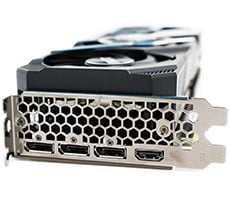
The outputs on the card are identical to the original and consist of a trio of full-sized DisplayPorts (v1.4 with DSC 1.2), an HDMI 2.0b port (with HDCP 2.2), and a proprietary VirtualLink USB Type-C port, which offers a 4 lane HBR3 DisplayPort and USB 3.1 Gen 2 over a single connector. An
NVLink connector also resided along the top edge of the board should you want to pair cards together in
SLI.
And now, without further delay, let’s see how the GeForce RTX 2080 Super performs...