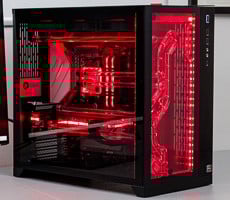
Our benchmarks here include Futuremark’s PCMark and 3DMark. PCMark 8 v2 is a cross-platform suite that gauges a system’s capabilities in several usage categories. The venerable 3DMark also has a suite of cross-platform tests, but these are tailored to measuring a system’s graphics chops.
 |
PCMark 8 Benchmarks
|
Productivity And System-Level Benchmarking
|
|
We selected three tests from the PCMark 8 benchmark suite: Home, Storage and Work. Futuremark recently improved its tests with PCMark 8 version 2. We selected the Open CL "Accelerated" options for both Home and Work.
Interestingly, the Dell Inspiron 15 7000 Gaming produced very strong results in all but the Home test, where it lagged just a bit behind some of its competitors. But it handled itself very well in the Work Accelerate and Storage tests.
 |
3DMark Fire Strike Extreme And Sky Diver
|
Synthetic DirectX Gaming And Graphics Testing
|
|
Futuremark designed 3DMark Fire Strike for desktop PCs, but today’s heavy-duty gaming laptops have the chops to take on the high-resolution texture, tessellation and other components of the test. Sky Diver, on the other hand, is aimed directly at gaming laptops and mid-range desktops.
Fire Strike Extreme is a bear on laptops with low-power GPUs, but the Inspiron 15 7000 Gaming held its own here, producing reasonable scores in both of 3DMark’s tests. That said, the scores also paint a clear picture of how increasing your budget will lead to a better-performing laptop. Alienware (and other) high-end gaming laptops may have bells and whistles that add to the overall cost, but they may be packing more powerful hardware too, which really shows in graphically intense tests.