Crucial BX300 3D MLC SSD Review: Affordable, Durable, Solid State Storage

Our Test Methodologies: Under each test condition, the Solid State Drives tested here were installed as secondary volumes in our testbed, with a separate drive used for the OS and benchmark installations. Out testbed's motherboard was updated with the latest BIOS available at the time of publication and AHCI (or RAID) mode was enabled.

The SSDs were secure erased prior to testing, and left blank without partitions for some tests, while others required them to be partitioned and formatted, as is the case with our ATTO, PCMark, SANDRA, and CrystalDiskMark benchmark tests. Windows firewall, automatic updates and screen savers were all disabled before testing. In all test runs, we rebooted the system, ensured all temp and prefetch data was purged, waited several minutes for drive activity to settle and for the system to reach an idle state before invoking a test.

HotHardware Test System
Intel Core i7 and SSD Powered
Processor -

Motherboard -


Video Card -

Memory -

Audio -

Storage -

Intel Core i7-7700K

Asus Z270 Deluxe
(Z270 Chipset, AHCI Enabled)

Intel HD 620

16GB Corsair DDR4-2666

Integrated on board

Corsair Force GT (OS Drive)
Intel SSD 545s
Samsung SSD 850 EVO
OCZ Trion 150
Crucial BX300
WD Blue 3D
SanDisk Ultra 3D
OS -

Chipset Drivers -

DirectX -

Video Drivers -

Benchmarks -
Windows 10 Pro x64

Intel 10.1.19, iRST 14.5.0.1081

DirectX 12

Intel HD 15.40.3.4248

IOMeter 1.1.0 RC
HD Tune v5.60
ATTO v3.05
AS SSD
CrystalDiskMark v3.0.3 x64
PCMark 7
SiSoftware Sandra
IOMeter
I/O Subsystem Measurement Tool
As we've noted in previous SSD articles, though IOMeter is clearly a well-respected industry standard drive benchmark, we're not completely comfortable with it for testing SSDs. The fact of the matter is, though our actual results with IOMeter appear to scale properly, it is debatable whether or not certain access patterns, as they are presented to and measured on an SSD, actually provide a valid example of real-world performance. In other words, the access patterns we tested here may or may not reflect your particular workload. That said, we do think IOMeter is a reliable gauge for relative available throughput within a given storage solution. In addition there are certain higher-end workloads you can place on a drive with IOMeter, that you can't with most other storage benchmark tools available currently.


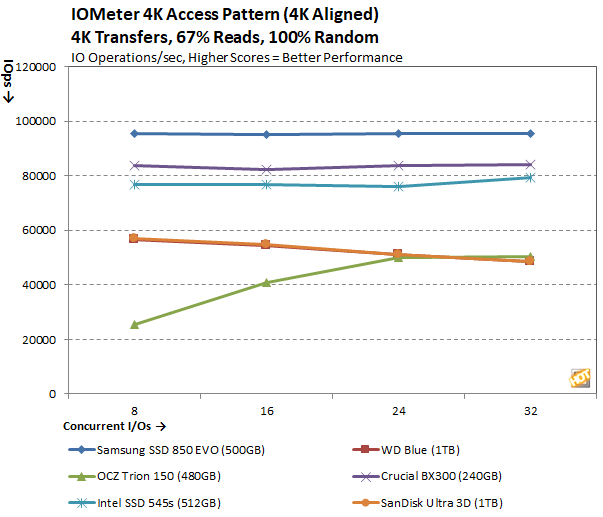
In the following tables, we're showing two sets of access patterns; our custom Workstation pattern, with an 8K transfer size, 80% reads (20% writes) and 80% random (20% sequential) access and a 4K access pattern with a 4K transfer size, comprised of 67% reads (34% writes) and 100% random access.
io1

io2  


The relatively low-capacity 240GB Crucial BX300 drive we tested performed well here. Depending on the access pattern, the Crucial BX300 put up numbers on par with or better than the recently released Intel 545s.

io3

The transfer rates during the high queue depth runs mirror what we saw in terms of IOPS -- the Crucial BX300 edges out the Intel 545s by a small margin and trails only the Samsung 850 EVO.


AS SSD Compression Benchmark
Bring Your Translator: http://bit.ly/aRx11n
Next up we ran the Compression Benchmark built-into AS SSD, an SSD specific benchmark being developed by Alex Intelligent Software. This test is interesting because it uses a mix of compressible and non-compressible data and outputs both Read and Write throughput of the drive. We only graphed a small fraction of the data (1% compressible, 50% compressible, and 100% compressible), but the trend is representative of the benchmark’s complete results.

as1

as2


The compressibility of the data being transferred on the Crucial BX300 has absolutely no impact on performance. Here, the Crucial BX300 offered smooth, consistent performance, consistent with the higher performance drives we tested.

Tags:  SSD, Storage, MLC, Crucial, imft, bx300
Marco Chiappetta

Marco Chiappetta

Marco's interest in computing and technology dates all the way back to his early childhood. Even before being exposed to the Commodore P.E.T. and later the Commodore 64 in the early ‘80s, he was interested in electricity and electronics, and he still has the modded AFX cars and shop-worn soldering irons to prove it. Once he got his hands on his own Commodore 64, however, computing became Marco's passion. Throughout his academic and professional lives, Marco has worked with virtually every major platform from the TRS-80 and Amiga, to today's high end, multi-core servers. Over the years, he has worked in many fields related to technology and computing, including system design, assembly and sales, professional quality assurance testing, and technical writing. In addition to being the Managing Editor here at HotHardware for close to 15 years, Marco is also a freelance writer whose work has been published in a number of PC and technology related print publications and he is a regular fixture on HotHardware’s own Two and a Half Geeks webcast. - Contact: marco(at)hothardware(dot)com

Related content