Biwin Black Opal DW100 DDR5 Review: High-Speed RAM For AMD And Intel PCs

Biwin Black Opal DW100 Memory Is Highly-Tuned Right Out Of The Box

| Biwin Black Opal DW100 (48GB, DDR5-6000): Currently $589 Biwin's DW100 high-speed, dual-channel DDR5 memory kit for enthusiasts leverages SK hynix RAM and offers excellent out-of-box performance.
|
|||

|

|
||
Unfortunately, DDR5 is hard to come by at the moment, no matter who you are, but we wanted to show you Biwin's latest consumer-class DDR5 memory kit, the Black Opal DW100 series, regardless. Although not as well-known as some of its competitors, Biwin has been around for quite a while; the company took on its current name in 2012, while its roots extend all the way back to 1995. However, the storage and memory vendor hasn't been able to play in the US market until recently.
Biwin is a Chinese company—from the mainland, not from Taiwan—and that can make it difficult to do business with the US and its allies due to the countries' on-again / off-again relationship. Given that, you might have clicked onto this article expecting to read a review of DDR5 memory based on DRAM chips from China's Changxin Memory, the country's first home-grown foundry to make competitive DDR5 memory products, but that is not the case. This Biwin Black Opal DW100 memory kit is actually based on SK hynix M-die DDR5 packages. These ICs are familiar to anyone with memory overclocking experience, as they form the basis for a huge portion of budget-conscious memory kits aimed particularly at new Ryzen system builders.
So, is there anything to talk about with this memory if it's based on familiar DRAM ICs? Or course there is. Biwin's responsible for building the memory modules, including all that entails, and the company has done a fine job doing so with this kit. The RAM comes in considerably fancier packaging than the majority of enthusiast-focused memory these days too, and I appreciated the foam used to keep the modules in place and safe during shipping.
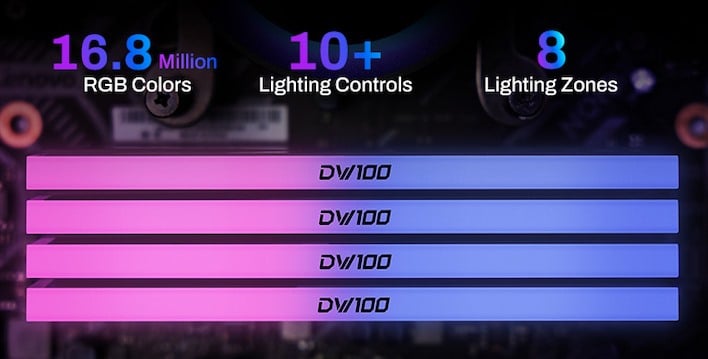
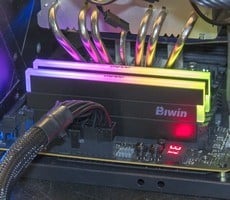
Like many modern memory modules aimed at enthusiasts and gamers, Biwin's Black Opal DW100 includes RGB LED accents along the top bar that can be synchronized with RGB LED lighting from all of the major motherboard vendors. The kit that we have here is a dual-channel kit with a pair of 24GB single-rank DIMMs that are designed to operate at 6000 MT/s with a 28-cycle CAS latency and an input voltage of 1.40 volts.
Biwin is offering a full range of memory modules starting at 6000 MT/s under the Black Opal line, so this is actually the most basic offering in the family. Speeds range all the way up to 8400 MT/s with CAS latencies ranging from 40 cycles down to 28; recall that memory latencies are measured in cycles, not real time, so how "good" a given latency is depends on the transfer rate. CL28 at 6000 MT/s is quite good, and it makes sense on the Ryzen platform popular with DIYers, where running faster memory speeds can be challenging.
Testing Biwin's Black Opal DW100 DDR5 Memory
Installing the pair of DIMMs into our ASRock Phantom Gaming X870E Nova Wi-Fi motherboard, I immediately set about investigating its characteristics. It booted up to a default speed of 5200 MT/s on this board. Notably, this kit supports both Intel's XMP as well as AMD's EXPO, but there's actually a 5600 MT/s 1.1v profile as well that saves some power and runs looser timings compared to the overclocked profiles.I spent more than three days carefully tuning the kit. As it turns out, Biwin has already done a pretty good job of that, as the default EXPO profile sets some fairly aggressive timings, and I really wasn't able to eke much more out of it. In fact, I wasn't able to take the clock rate above 6200 MT/s at all, even going all the way to 1.5v. I could get 6400 MT/s to boot, but it wasn't stable. Likewise, the primary timings were dialed in, and I couldn't lower them at 6200 MT/s.

Click These To See The Fine-Grained Partitculars
My experience tweaking this memory kit is pretty consistent with what we expect from SK hynix M-die DDR5, which often hits a clock wall not long after 6000 MT/s. Our tweaked settings do result in considerable improvements in memory latency, cutting it from 77.6ns on the default settings down to 58.6ns in the tweaked configuration. However, the one-click process of enabling the EXPO profile got us to 64.6ns, which is more than respectable.
I actually spent much longer than I should have attempting to squeeze performance gains out of the system. I ran all kinds of stress tests and benchmarks before realizing that the memory was simply already tuned close to its limits and that I wasn't going to get much more out of it. I picked a few benchmarks to share to give you an idea of the performance gains you can get on a Ryzen processor with faster memory, and how important manual memory tuning really is.
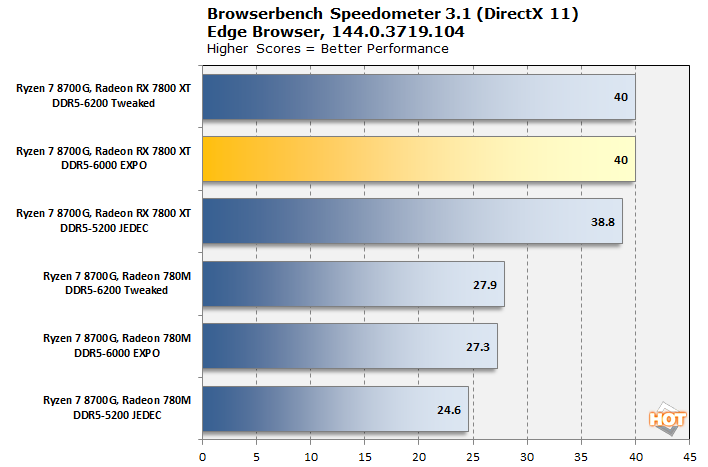
We'll start with Browserbench Speedometer. When testing with the Ryzen 7 8700G's integrated graphics, bumping up the memory speed had a significant effect on performance in this benchmark. However, with the more powerful Radeon RX 7800 XT installed, EXPO got us to exactly the same results as our long hours of manual tweaking. That's going to become a bit of a trend, as you'll see.
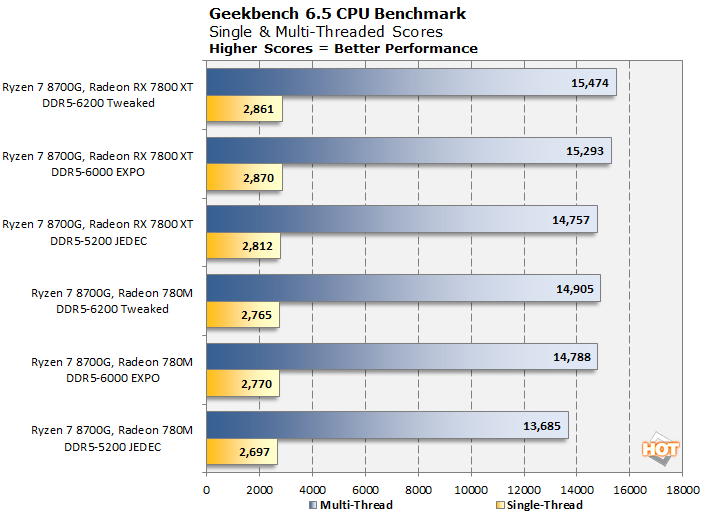
In Geekbench 6.5, we see a similar pattern emerge. Installing the discrete GPU has a larger effect than most of our memory tuning, as it offloads graphics processing (and the associated memory load) to the secondary processor, allowing our eight Zen 4 CPU cores to stretch their legs. Memory tuning certainly helps, though, particularly for the multi-core scores. Interestingly the Tweaked configurations saw small but repeatable regressions in the single-core scores despite offering higher multi-core performance.

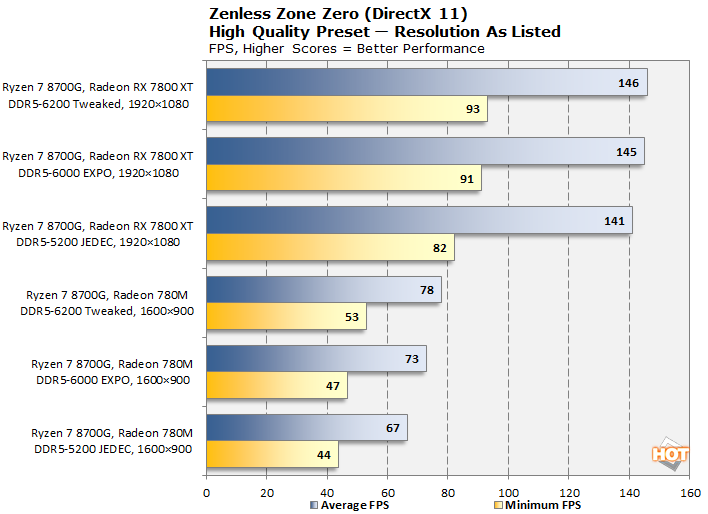
In gacha waifu-'em-up Zenless Zone Zero, we see two patterns very typical of memory tuning. When using integrated graphics, we unsurprisingly see performance continue to improve as the transfer rate goes up and the latency goes down. However, you can also see memory latency gains improving the worst-case 1% low frame rates even with the discrete GPU, especially when moving from slow JEDEC timings to fast EXPO profiles.

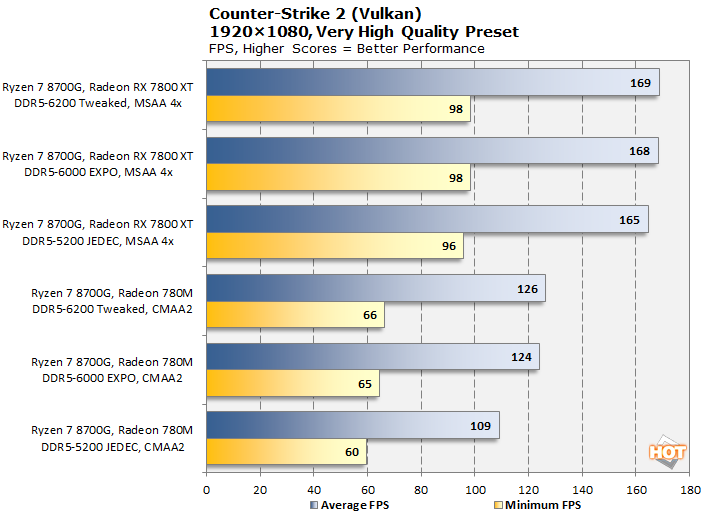
Counter-Strike 2 tells a similar story. The integrated GPU benefits massively from the move to the EXPO profile, but gets almost nothing from the extra time spent tweaking and tuning. The Radeon RX 7800 XT configuration sees a much smaller benefit, likely due to the game's 4x multi-sampling putting a much heavier load on the GPU, relatively speaking.

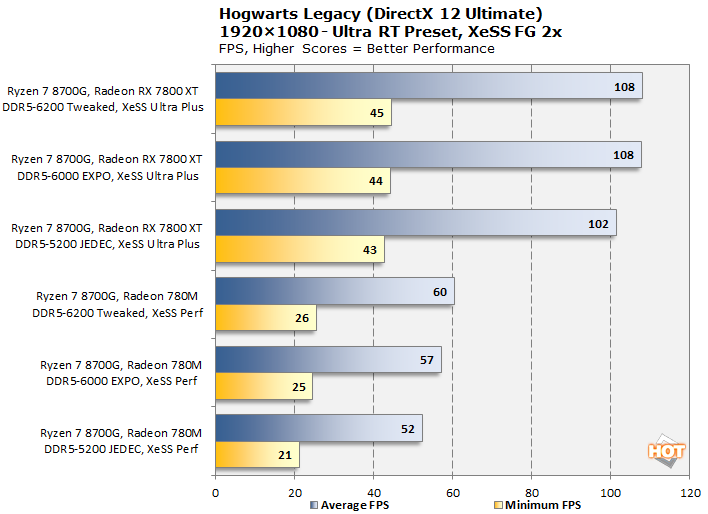
Finally, in Hogwarts Legacy, we decided to layer on every advanced rendering technology we could to see how it would interplay with RAM overclocking. So, this test has every ray-tracing feature enabled as well as every XeSS feature: upscaling, low-latency mode, and frame generation—yes, even on the integrated GPU. The results speak for themselves: memory tuning still matters a bit, even if you're spinning up GPU cores to AI-generate 7/8ths of every two frames.
Biwin's RAM Holds Up Under Fire
In the end, whether we can truly recommend this RAM is going to depend on its pricing, and that's going to depend on market conditions (currently $568 on Amazon). The irony of reviewing a mid-range memory kit in the current "RAMageddon" is not lost on us. What we can tell you is that Biwin's memory performs well, as expected, and it will do so in both AMD and Intel motherboards—we also tested it in our MSI MEG Z890 ACE Arrow Lake board, and it operates perfectly there, too.
Biwin did a good job binning and tuning this RAM. There's not a lot of overclocking headroom, which may be frustrating as an overclocker, but ultimately a good thing for most other consumers. That means you can set the XMP or EXPO profile and enjoy nearly optimal overclocked memory performance without the hassle of doing it yourself. Like a couple of its competitors, Biwin offers a limited lifetime warranty on its memory products, which certainly inspires confidence.
If you see a kit of Black Opal DW100 on sale for a price that's palatable, don't hesitate to snap it up. This is quality RAM that any enthusiast should be satisfied to stick in their system.