ATI Radeon X1650 XT with Native CrossFire

Performance Comparisons with FarCry v1.33
Details: http://www.farcry.ubi.com/

FarCry
If you've been on top of the gaming scene for some time, you probably know that FarCry was one of the most visually impressive games to be released on the PC in the last few years.  Courtesy of its proprietary engine, dubbed "CryEngine" by its developers, FarCry's game-play is enhanced by Polybump mapping, advanced environment physics, destructible terrain, dynamic lighting, motion-captured animation, and surround sound. Before titles such as Half-Life 2 and Doom 3 hit the scene, FarCry gave us a taste of what was to come in next-generation 3D gaming on the PC. We benchmarked the graphics cards in this article with a fully patched version of FarCry using a custom-recorded demo run taken in the "Catacombs" area checkpoint. The tests were run at various resolutions with 4X AA and 16X aniso enabled concurrently.

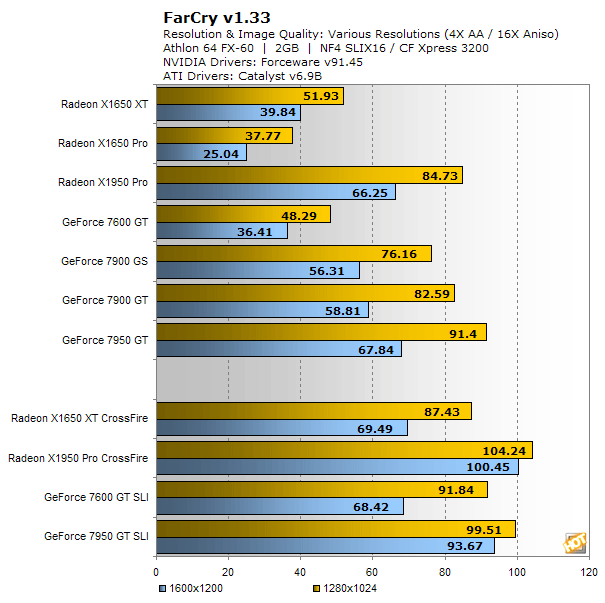
The new Radeon X1650 XT performed relatively well in our custom FarCry benchmark. Here, the X1650 XT was about 10% faster than the GeForce 7600 GT at both resolutions when running in single-card mode. Things took a turn for the worse once we enabled CrossFire though.  In CrossFire mode, a pair of Radeon X1650 XT cards loses out to a GeForce 7600 GT SLI configuration by about 5% at 1280x1024. But with the resolution turned up to 1600x1200, the Radeon X1650 XT cards come back strong and squeaks out a slight victory over the GeForces.


Marco Chiappetta

Marco Chiappetta

Marco's interest in computing and technology dates all the way back to his early childhood. Even before being exposed to the Commodore P.E.T. and later the Commodore 64 in the early ‘80s, he was interested in electricity and electronics, and he still has the modded AFX cars and shop-worn soldering irons to prove it. Once he got his hands on his own Commodore 64, however, computing became Marco's passion. Throughout his academic and professional lives, Marco has worked with virtually every major platform from the TRS-80 and Amiga, to today's high end, multi-core servers. Over the years, he has worked in many fields related to technology and computing, including system design, assembly and sales, professional quality assurance testing, and technical writing. In addition to being the Managing Editor here at HotHardware for close to 15 years, Marco is also a freelance writer whose work has been published in a number of PC and technology related print publications and he is a regular fixture on HotHardware’s own Two and a Half Geeks webcast. - Contact: marco(at)hothardware(dot)com

Related content