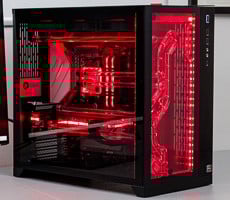
Dell Alienware Area-51 Core i7-980 X Infused Gaming PC

Dell Alienware Area-51

Intel Core i7-980 X 3.33GHz
Alienware X58 ATX
6GB Elpedia DDR3-1333
ATI Radeon 5970 CrossFire
2x1TB Seagate HDD RAID 0
Win 7 Home Premium x64
Price: $ 4,419.00 USDDigital Storm i750
Intel Core i5 750 @ 3.8GHz
EVGA P55 FTW ATX
4GB Mushkin DDR3-1600
NVIDIA GeForce GTX 275 SLI
1TB WD Caviar Black
Vista Home Premium x64
Price: $ 1896.00 USD Origin Genesis
Intel Core i7-920 @ 3.8GHz
EVGA X58 SLI Classified
6GB Corsair DDR3-1600
2x ATI Radeon 5970 Crossfire
2TB WD Caviar Black RAID 0
Win 7 Home Premium x64
Price: $4,999 USD CyberPower Gamer Extreme 3000
Intel Core i7 860 2.8GHz
Asus P7P55D Delux P55
4GB Kingston DDR3-1600
EVGA NVIDIA GTX 295
1.5TB Seagate HDD
Vista Home Premium x64
Price: $ 1,599.00 USD
We began testing with SiSoftware's SANDRA, which stands for System ANalyzer, Diagnostic and Reporting Assistant. The 3.3GHz Core i7-980 X Dell Alienware system proved rock-solid-stable at 3.8GHz, never crashing even under full load throughout all our benchmarks, so we left it configured that way. Please note, this is a preset Dell configuration in the BIOS that configures the Core i7's maximum Turbo Boost multiplier to 28X. However, Dell ships the system at a stock reference clock of 3.33GHz.
 |
Preliminary Testing with SiSoft SANDRA 2009 |
| Synthetic Benchmarks |


The outcome of our SANDRA performance tests are what we'd call a no brainer. The 6-core Core i7-980X enabled Alienware Area-51 ripped through the Arithmetic and Multimedia benchmarks, offering up to an 80+ percent performance gain in the arithmetic test and over 50% more headroom on the multimedia test. Intel's Hyperthreading technology affords the Gulftown-based Area-51 four more logical cores to process workload in addition to its significantly larger on-chip cache. On the memory bandwidth side of the equation, the Area-51 fell slightly behind the Origin Genesis system, with its DDR3-1600 (versus Alienware's 1,333MHz) memory at the helm. We'll look into whether this makes any significant difference in performance in more real world applications coming up shortly.

Just for a quick cursory glance, we thought we'd show you the SANDRA Physical Disk test performance graph for the RAID 0 array of the new Area-51. It's not a barn-burner of a storage subsystem but the pair of Seagate Barracuda drives in RAID 0 certainly offer a fair degree of bandwidth, approaching SSD-like speeds, though random access latency is of course order of magnitude slower for spinning media.