



Microsoft Reveals Project Solara, An Android-Based OS For AI Agents


The core pitch is that building specialized hardware has historically been brutal. Companies had to design the silicon, the OS, the UI, the developer tools, and the security model from scratch. Project Solara tries to work around that complexity by letting AI do a lot of the heavy lifting. The goal is to make it much cheaper and less painful to build purpose-built hardware, so that deploying an AI agent into a specific job doesn't require rebuilding the whole software stack from scratch.
Rather than requiring developers to redesign their software for every new screen size or input method, the platform uses what Microsoft calls "just-in-time user interfaces." Depending on the device, that might mean a touchscreen layout, a voice interface, or something in between, without developers having to design each one separately. The long-term vision is fully generative interfaces that assemble on the fly based on what a user actually needs.
The operating system underneath all of this is built on the Android Open Source Project (AOSP), which gives it a familiar foundation and lets IT departments manage devices using tools they already know, like Microsoft Intune and Entra ID. There is also support for Windows Hello for Business biometrics, physical microphone mute buttons, and explicit recording indicators, all of which matter quite a bit when someone is deploying always-on AI hardware in enterprise environments.
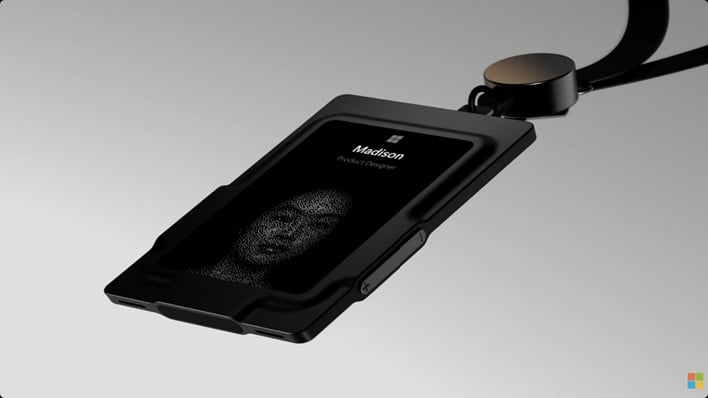
Microsoft showed off two concept devices at the event. The first is a wearable AI badge aimed at frontline workers, nurses, and corporate staff. It runs on Qualcomm wearable silicon and packs a touchscreen, a side-facing camera, a far-field microphone array, and Wi-Fi, Bluetooth, and 5G connectivity. A fingerprint sensor handles authentication. The idea is that a nurse or warehouse worker can tap the badge to pull up a prioritized schedule or authorize the device to record and transcribe a conversation on the spot. Qualcomm has been one of Microsoft's closest hardware partners on AI-forward devices.
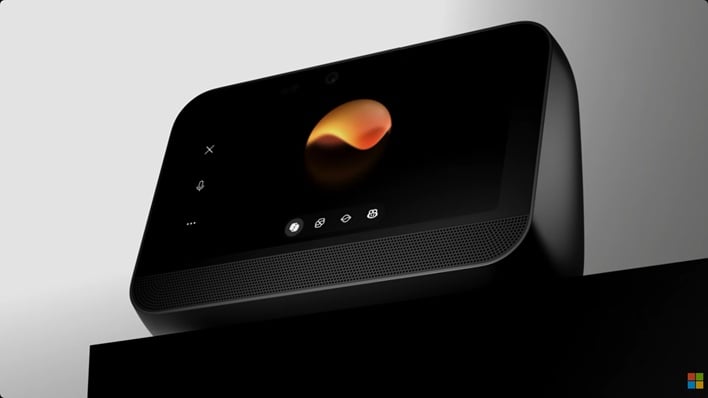
The second device is a desk companion built on MediaTek IoT silicon. It has a touchscreen, a dual-microphone array, a speaker, and an ultra-wideband presence sensor that can detect when you walk up to it. It supports facial recognition for login, integrates with Microsoft 365 Copilot, and can operate as a standalone device, a companion to a Windows PC via Bluetooth, or even a thin client when hooked up to an external display.
Project Solara is also part of Microsoft's broader Build 2026 developer platform announcements, where it sits alongside new agent security tools like Microsoft Execution Containers (MXC), a policy-driven system that lets developers define exactly what an AI agent can access, with those restrictions enforced at the OS level. That kind of containment is a big deal as agents get more autonomous and companies worry about what they might do when left to their own devices. That's a notable contrast for a company that, earlier this year, was reported to be pulling back on AI bloat across Windows 11 after user push-back, suggesting Solara represents a deliberate effort to move heavy agent workloads off the main Windows OS and onto purpose-built hardware entirely.
For context, Microsoft confirmed earlier this year that Windows 12 isn't happening in 2026, with the focus instead on stabilizing Windows 11. Building a parallel agent-first platform like Solara looks like a way to push into new territory without touching the core OS at all.
Microsoft says it has already been piloting the hardware internally, with hundreds of employees using it for tasks like meeting transcription, project tracking, and real-time coaching. GitHub Copilot and Dragon Copilot are both being tested on the platform, the latter focused on helping healthcare workers capture patient interactions during care.
A private pilot program is coming in the next few months, with partners including AccuWeather, Best Buy, CVS Health, Levi's, and Target. The hardware ecosystem is being built in collaboration with MediaTek, Qualcomm, and various OEM partners, with target industries including healthcare, retail, financial services, and manufacturing.
It is early days, and concept hardware does not equal shipping hardware. But for enterprise customers, Project Solara is a genuinely interesting signal about where Microsoft sees the next wave of device categories going. Don't, however, expect a consumer version just yet.





