



Intel Wildcat Lake Specs Leak Reveals Up To A 4.8GHz Boost And Dual Xe3 GPU Cores


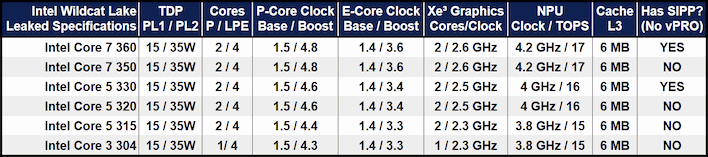
Just as previously leaked, Intel will be branding the Wildcat Lake family as the Core 300 series. The list of specs goes into considerable detail, including turbo bins when one or both P-cores are active, GPU clock rates, NPU specifications, and feature support for things like Intel vPro and Intel's Stable IT Platform Program. A few details stand out to us: the whole line gets the full (albeit tiny) 6MB L3 cache, only a single processor drops any of the CPU and GPU cores, and the NPU isn't fast enough to earn machines with these chips Copilot+ designation from Microsoft... not that such branding has done anything for sales.
If you're a novice, or just catching up, these chips might seem underwhelming because they're explicitly not replacing Panther Lake. Instead, these are replacing Twin Lake, which didn't even have any P-cores (just eight Gracemont E-cores.) See, Panther Lake is a powerful but complicated processor family, which makes it expensive to manufacture. Wildcat Lake is a significantly smaller and simpler design, but that's why it tops out at just six CPU cores and two GPU cores, with the latter even lacking ray-tracing support.
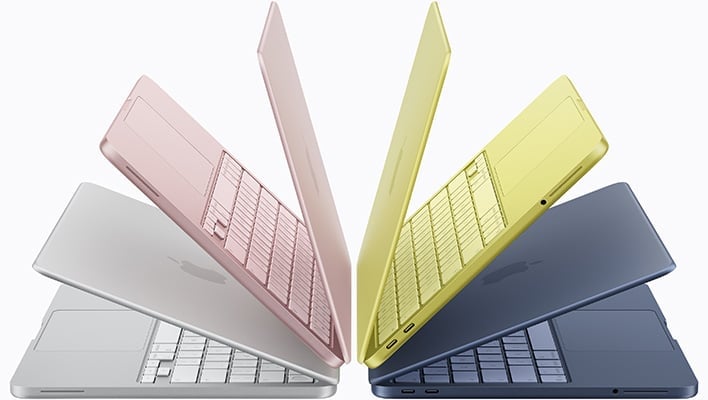
Modern CPUs are real darn fast, though, and anyway, since when did a six-core processor become weak? Notably, this is the same configuration you'll find (albeit with a larger GPU) in the Macbook Neo, a comparison we've actually gone over in depth already. Suffice to say that we expect the Core Series 3 processors to, uh, suffice, likely for a huge portion of the laptop market.
Of course, as they say, there are no bad products, only bad prices, so it's all going to come down to how proud of these parts Intel is. Judging by the pricing of the recent Core Ultra 200S Plus CPUs, Intel may have finally learned its lesson about premium pricing for processor products that don't necessarily prompt such plutocratic policies. Hopefully we see some real $599 competitors to the Macbook Neo with Wildcat Lake.





