



Intel Wildcat Lake Benchmarks Reveal Potential Rival To $599 MacBook Neo


It's still early, but the MacBook Neo may be the biggest threat to Windows laptops to date, particularly in the current climate that has seen certain PC component prices soar. A possible challenger could come in the form of Intel's upcoming Wildcat Lake lineup, and in particular a 5-core model that has just been spotted on Geekbench.
Wildcat Lake is expected to power a new breed of budget laptops, including a pair of notebooks that MSI unveiled at CES, the Modern 14S and Modern 16S. Some early spec sheets reveal that both models will feature Intel Core 300 chips, otherwise known as Wildcat Lake, while the Modern 14S AI+ and Modern 16 AI+ will tap Intel Core Ultra 300 processors, otherwise known as Panther Lake.
Panther Lake is already here, with Intel having launched its latest generation mobile processors based on 18A at CES, and we're seeing laptop designs start to trickle into marketplace. Case in point, Razer refreshed its Blade 16 with Panther Lake (along with several other upgrades).
Wildcat Lake is essentially a tamer version of Panther Lake. The low-power lineup is expected to feature up to six CPU cores, two Xe3 GPU cores, and a dedicated NPU capable of a modest 18 TOPS, which is not enough to earn a Copilot+ designation.
Can Wildcat Lake bring the fight to Apple's MacBook Neo, which is powered a version of the A18 Pro that is also found in the iPhone 16 Pro Max and iPhone 16 Pro. Time will tell, but we're starting to see some benchmarks emerge.
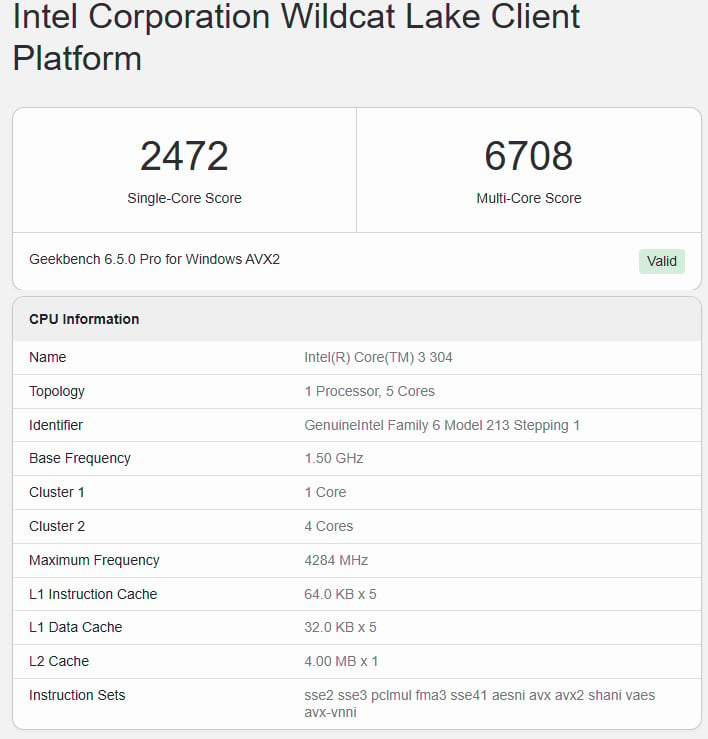
A recent entry in Geekbench highlights a Core 3 304 Wildcat Lake processor with five cores. According to the database entry, the chip features a 1+4 core configuration, suggesting a single Cougar Cove performance core and four Darkmont efficiency cores. It's also shown with a 1.5GHz base clock and, if digging into the details, a maximum frequency of 4.28GHz (4,284MHz). So basically a 4.3GHz turbo frequency.
It's possible that Geekbench is not identifying the chip correctly. Even if it is, however, finalized specifications could differ from early engineering samples like this one.
For what it's worth, the Geekbench entry (as spotted by Videocardz) shows a 2,472 single-core score and 6,708 multi-core score. Geekbench is not yet including the MacBook Neo in its roundup of average scores for different chips and platforms, though a recent benchmark run shows the base model scoring 3,566 in the single-core test and 8,646 in the multi-core test.
It's way too early for performance comparisons, but if insisting, the MacBook Neo's single-core score is 44.3% higher and the multi-core score is 28.9% higher.
We'll have to wait and see how a new crop of affordable laptops compare to the $599 MacBook Neo. Likewise, it will be interesting to see if Microsoft makes good on its promise to refine Windows as it pulls back on Copilot features and rethinks its AI strategy. For some, that will be just as important as the benchmark comparisons.




