



MSI Laptops With Intel Wildcat Lake Are Coming To Rival Apple's MacBook Neo


Spotted and photographed by Japanese site Levelup Logy at an MSI Computer Japan event, the new Modern 14S and Modern 16S laptops come in standard and AI+ versions. The Modern AI+ laptops will use Panther Lake processors and will likely be priced a fair bit higher than the versions missing the AI+ appellation, which we expect will be based on low-cost Wildcat Lake chips.

These machines are quite thin and light.
So what is Wildcat Lake? It's kind of like a baby Panther Lake. These chips have up to six CPU cores, two Xe3 GPU cores, and an 18 TOPS NPU, which disqualifies it for Microsoft Copilot+ certification. It's also apparently low-power enough that Intel doesn't even grant it "Core Ultra" branding; these chips make up the "Intel Core 300" family, which is what MSI lists for the Modern 14S and Modern 16S in their "non-AI+" incarnations.
The biggest weakness in Wildcat Lake versus Panther Lake is really the memory interface, though. Wildcat Lake, like previous low-end SoCs from Intel (such as Twin Lake), is limited to a 64-bit memory bus. This means a max of two DIMMs, period, and usually only one thanks to the intention to hit maximum transfer rates as a means of compensating for the narrow memory interface. This memory bandwidth limitation will further hamstring graphics performance, although it likely makes the chip very inexpensive to make--relatively speaking.
So does that mean Wildcat Lake can't really compete with the A18 in the MacBook Neo? Well, maybe. Almost certainly in terms of graphics; while its GPU will probably be clocked a bit higher, it's got a much smaller GPU, and it will likely ship with slower memory than the 7500 MT/s LPDDR5X in the MacBook Neo, too.
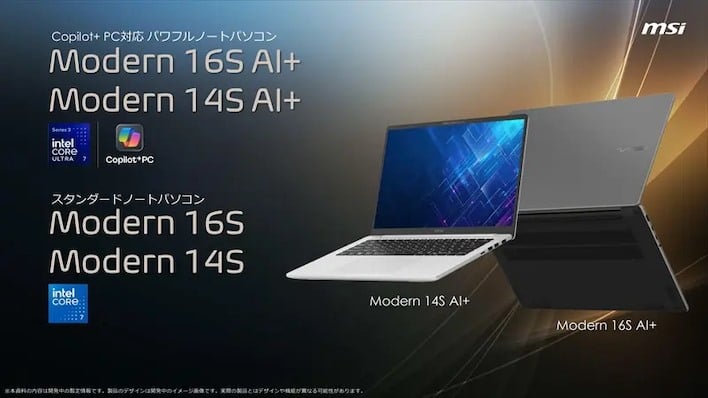
The AI+ versions use Panther Lake processors, but are otherwise nearly identical.
However, the CPU comparison is arguably the more interesting one. Wildcat Lake's top configuration will come with a pair of Cougar Cove P-cores, which we've observed to be very fast in Panther Lake. Are they competitive against the speedy Everest performance cores in the A18? We'll have to see. It's also going to come with a cluster (4 cores) of Darkmont E-cores. While Darkmont isn't as powerful as a 'Cove' family core, it's capable of massive multi-core throughput, and we doubt the "Sawtooth" efficient cores in the A18 can keep up.
With that in mind, we expect Wildcat Lake will lose in graphics, be competitive-or-better on a single core, and destroy the MacBook Neo's A18 in multi-core performance. The real place it wins is actually I/O, though. The A18 was designed for smartphones and as a result, the MacBook Neo has absolutely abominable I/O: a measly two USB ports, one of which is USB 2.0, a headphone jack, and that's it. You don't get an HDMI port for projectors, you obviously don't get an Ethernet port, and you don't get Thunderbolt or anything of the sort.
By comparison, the MSI Modern 14S with a Core 300 Series processor has Gigabit Ethernet, two 10-gigabit USB Type-C ports, two 5-gigabit USB Type-A ports, an HDMI port, a MicroSD card reader, and an audio combo jack. The comparison against the cheapest MacBook isn't even salient. Reportedly, Wildcat Lake can also support Thunderbolt 4, although it's not implemented here (likely for cost reasons.)

Images: MSI, via Levelup Logy
According to information from MSI (via Levelup Logy), the Modern 14/16 laptops actually have the exact same capabilities as the AI+ versions based on Panther Lake except for three changes: the SoC (obviously), the addition of a second SODIMM slot on the AI+ models, and a larger battery for the Core Ultra systems. The Wildcat Lake machines come with a 42 Whr battery, while the faster systems get 60-Whr batteries. Both are bigger than the 36.5 whr battery in the MacBook Neo, although that machine is smaller and likely more efficient, too.
No word on pricing or availability yet, of course, and to be honest, since these systems were revealed at a Japanese event, it's entirely possible that they won't even come out over here. We'd be surprised, though; MSI sells a lot of laptops in the US. Mainstream hardware might not be as exciting as the fight for total performance supremacy at the high-end, but a lot more people use these products, so it will be interesting to see how this matchup actually goes once systems with Core Series 3 chips are available later this year.
Thanks to Videocardz for the spot.





