



28 Core Laptops? Intel Nova Lake-HX Leak Puts AMD Zen 6 On Notice


Posting on Xwitter as usual, Jaykihn revealed the core counts of Nova Lake-HX configurations. You can read the screenshot below, but for the benefit of those with screen readers, one configuration is apparently "4+8+4+2," while the other is "8+16+4+2". Those numbers should be read as Coyote Cove P-core count, Arctic Wolf E-core and LP E-core count, and then Xe3-LPG GPU core count. The E-cores and LP E-cores differ primarily by clock and location; the E-cores live on the Compute tile with the P-cores (and share L3 cache), while the LP E-cores live on the SoC tile.

You might be thinking, "but, Nova Lake is going to have 52 CPU cores, right?" Well, yes, in the top-end desktop configuration. However, the "8+16+4+2" configuration exactly matches the desktop Nova Lake-S in its "1 compute tile" configuration. Most likely, the configuration with two compute tiles won't come to mobile simply because it is too power-thirsty; early rumors put those chips at peak power draw of over 700 watts, which simply isn't going to fly in a laptop no matter what.
So that gives us one compute tile with eight P-cores and sixteen E-cores, as well as four LP E-cores on the SoC tile, same as the desktop chip. No word on whether there will be a bLLC version for the HX platform, but if such a part materializes, it will likely be a halo product and extremely expensive. However, AMD does ship 3D V-Cache processors for mobile, so if Intel wants to compete in gaming, that might necessarily be the move.
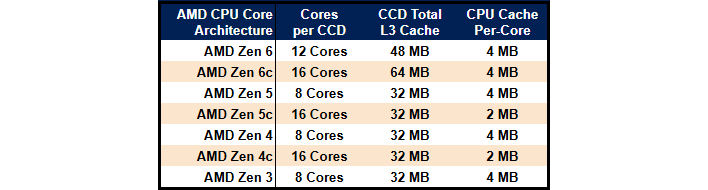
AMD's Zen 6 architecture is well-known to be moving to a twelve-core CCD, meaning that processors based on those CCDs will count cores in twelve-core increments. The company isn't expected to ship a consumer processor with more than two CCDs, so that puts AMD's top-end next-generation mobile offering at a maximum of 24 CPU cores. Now, 24 Zen 6 cores is probably going to outpace Nova Lake's 28-core hybrid configuration, but it's not necessarily clear that AMD will actually ship a 24-core CPU for mobile due to power and thermal limits.
Either way, it's clear that Intel will have the edge in numeric core count if not in actual multi-core performance. Personally, for this enthusiast's money, I'm more interested in the matchup between AMD's upcoming Medusa Point and whatever follow-up to Panther Lake Intel has planned. A handful of CPU cores and a big fat GPU on a single package is simply a more sensible configuration when you're tightly power- and heat-constrained.





