



AMD Zen 6 Medusa Point CPU Spotted With 10 Cores And More L3 Cache


Another unreleased processor has found its way to Geekbench's benchmark database and according to the details in the listing, it is likely an early engineering sample of a Medusa Point APU based on AMD's next-generation Zen 6 architecture. While it's premature to draw any real conclusions (particularly performance), there are some interesting details in the listing.
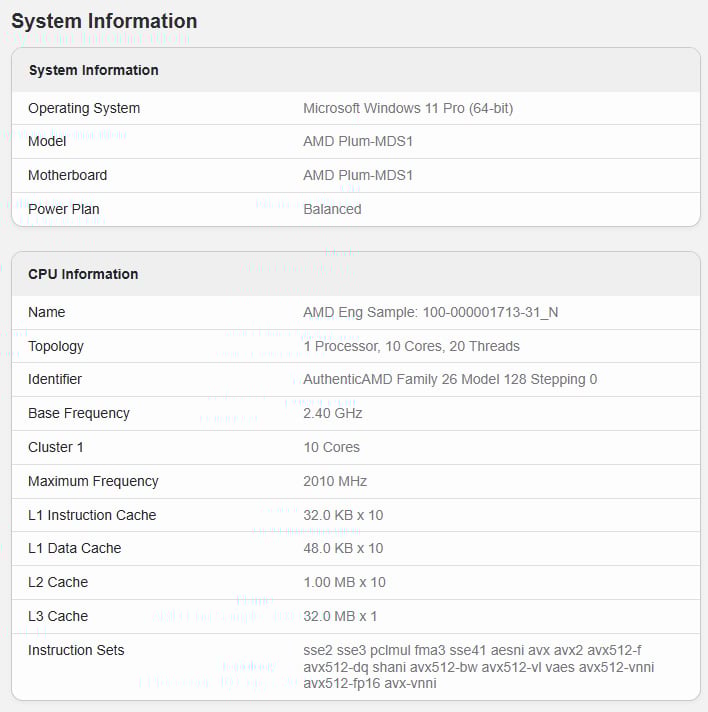
For one, there is no Ryzen designation on the main listing. Instead, it's identified by Geekbench as as "AMD Plum-MDS1" and also "AMD Eng Sample: 100-000001713-31_N." Back in August of last year, notable leaker @Olrak29_ on X highlighted a Plum FP10 platform (as spotted by WCCFTech at the time) listed on a shipping manifest, and it's widely believed to be a testing platform Medusa Point. It's also worth noting that the benchmark log lists it as an AMD Ryzen 9 chip.
Another interesting detail is the core and thread configuration. Geekbench identifies the chip as having 10 cores and 20 threads with a 2.4GHz base clock, though it was actually running at just over 2GHz for the benchmark entry. There are a various reasons why this might be, the obvious one being it was a simple internal test by AMD or one of its hardware partners.
Source: Geekbench
There is no mention of different core types, though given the early nature of the leak and the engineering sample status, it's possible (and likely) that Geekbench couldn't identify the breakdown. As points of reference, AMD's 10-core/20-thread Ryzen AI 9 365 Strix Point and Ryzen AI 9 465 Gorgon Point chips both feature four Zen 5 cores and six Zen 5c cores.
Perhaps the most interesting bit, however, is the cache breakdown. According to the list, the supposed Medusa Point chip features 10MB of L2 cache and 32MB of L3 cache, for 42MB of total cache. The amount of L2 cache is the same as found on the aforementioned Strix Point and Gorgon Point APUs, but the L3 cache is 33.3% more.
Did AMD bump up the amount of cache for its Medusa Point chip? It's possible, and combined with the jump to a new architecture and presumably faster built-in graphics (though maybe not RDNA 4), AMD's next-generation mobile APUs could deliver a decent all-around performance uptick.
Being an engineering sample and an early one at that, however, it's best to temper expectations for the time being. If leaked roadmaps are any indication, AMD is targeting 2027 for Medusa Point.
Hat-tip to BenchLeaks for spotting the apparently Medusa Point listing.




