



ASUS, Gigabyte And NVIDIA Clarify GeForce RTX 5070 Ti And 5060 Ti 16GB Availability


No, ASUS is not designating its GeForce RTX 5070 Ti or the 16GB version of its GeForce RTX 5060 Ti graphics cards as end of life, despite reports to the contrary. In a statement issued this morning, ASUS clarified where things stand in regards to its GeForce RTX 50 series models with 16GB of VRAM and blamed apparent erroneous reports on media receiving "incomplete information" from one of its PR personnel.
ASUS Issues Statement On GeForce RTX 5070 Ti And 5060 Ti 16GB Situation
"The GeForce RTX 5070 Ti and GeForce RTX 5060 Ti 16 GB have not been discontinued or designated as end-of-life (EOL). ASUS has no plans to stop selling these models," ASUS said in no uncertain terms.
"Current fluctuations in supply for both products are primarily due to memory supply constraints, which have temporarily affected production output and restocking cycles. As a result, availability may appear limited in certain markets, but this should not be interpreted as a production halt or product retirement," ASUS added.
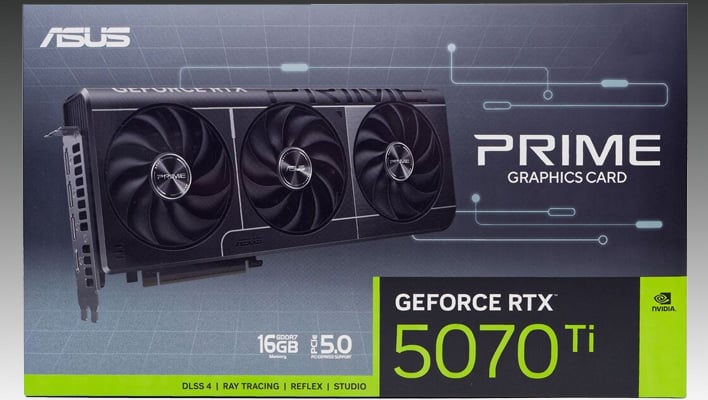
The brouhaha over the status of ASUS-brand GeForce RTX 5070 Ti and GeForce RTX 5060 Ti 16GB models stemmed from comments an ASUS representative made to Hardware Unboxed (hardwareLUXX) at CES earlier this month. In a video posted to YouTube, the outlet claimed it was "explicitly told" by ASUS that as a result of facing a supply shortage, the company placed the GeForce RTX 5070 Ti into EOL status with no plans to produce more models.
News of the status change spread like wildfire, in part because ASUS is NVIDIA's largest add-in board (AIB) partner, have catapulted to the top spot after EVGA severed ties with NVIDIA and exited the graphics card business, stage left. The implication is that if NVIDIA's biggest hardware partner is effectively cancelling a particular SKU, then so would every other player.
According to ASUS, that is not the case. ASUS also said that it will continue to support both the 5070 Ti and 5060 Ti 16GB and is "working closely with partners to stabilize supply as conditions improve."
NVIDIA And Gigabyte Sound Off
Therein lies the rub in all of this—the challenge of sourcing memory chips to keep cranking out higher VRAM models. In a separate but related statement to the same outlet, NVIDIA acknowledged that "memory supply is constrained" while demand for its GeForce RTX lineup is "strong."
"We continue to ship all GeForce SKUs and are working closely with our suppliers to maximize memory availability," NVIDIA said.
The unfortunate reality is, there is only so much memory allocation to go around and a huge chunk of it is being earmarked for data center customers as AI demand continues to soar. There are higher margins in the data center versus the consumer sector, and so suppliers and chip makers are following the money trail.
Adding some context to the situation, Gigabyte CEO Eddie Lin told Tom's Hardware that NVIDIA's overarching GPU allocation strategy in the consumer segment is to maximize profit from limited memory resources.
"They cannot produce only high-end or low-end [models]... but they can, for example, they have 1, 2, 3, 4, 5, five segments. They focus on 1, 3, and 5, and reduce the percentage on 2 and 4, because on 2 and 4, the revenue contribution per gigabyte of memory is lower. They will calculate how much revenue [each segment] contributes per gigabyte of memory," Lin said.
To give an example, Lin said on $300 GPU, the memory may contribute $35 per GB of revenue, "whereas for a $400 8GB GPU, that product would contribute $50 per GB of memory." In comparison, a $500 card with 16GB of VRAM breaks down to $32 of revenue per gigabyte.
It's not clear if those figures are how it actually breaks down, but the point is clear all the same. It's all about maximizing profit on a limited and tight supply of memory chips, and lower VRAM models are more profitable.
So no, NVIDIA and its partners have not designed any GeForce RTX 50 series SKUs as EOL, but certain models may be tougher to come by all the same.




