



Intel Arrow Lake Refresh Flexes Faster DDR5 Memory, Nova Lake Gets A Big NPU Boost


We reported last week on some leaked details for Intel's upcoming Arrow Lake Refresh processors. As a refresh, these new chips don't seem to do much to differentiate themselves from the extant Core Ultra 200S family, but one small upgrade mentioned in that leak was a move to DDR5-7200 memory as standard. Now, we have confirmation on that direct from Intel itself, as well as a trio of new rumors regarding Intel's actual next-gen desktop processors code-named Nova Lake.
First up, the Arrow Lake Refresh memory speed confirmation. This comes by way of Uniko's Hardware, who points out on Xwitter that Intel has updated its Plan of Record document for the Core Ultra 200S family. This is probably happening because the refreshed chips are not going to be called the Core Ultra 300S family, but rather branded with model number increases and "Plus" after the number, like "Core Ultra 9 290K Plus". We speculated last week that the Plus could be indicative of less obvious upgrades, but that's pure speculation on our part.
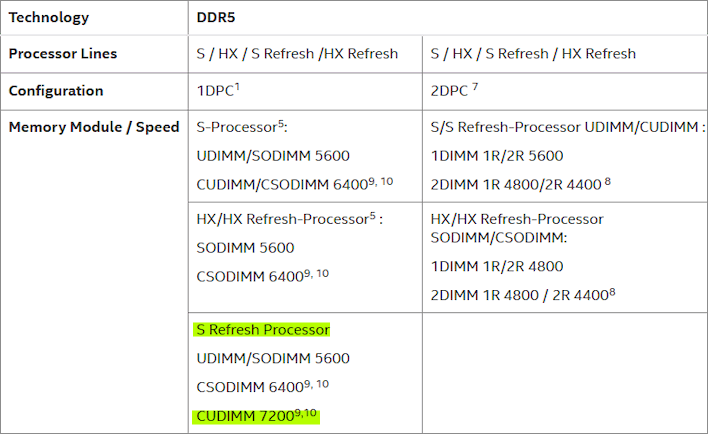
The updated Plan of Record specifically lists "Refresh" processors, and it states that for "S Refresh" processors—that's the desktop Arrow Lake Refresh chips—standard UDIMM/SODIMMs will be limited to 5600 MT/s and CSODIMMs can hit 6400 MT/s, as before. However, systems with full-sized CUDIMMs will indeed be able to run at 7200 MT/s without any overclocking. That means no UEFI tweaking necessary; plug in the hardware, boot the machine, and you've got your RAM running at 7.2 Gbps per signal pin. That's a bump from ~100 GB/sec to ~112.5 GB/second, which ain't bad at all.
Of course, the extra memory bandwidth doesn't do much on its own—at least, for anyone besides folks who are gaming on the mediocre integrated graphics. Where Arrow Lake desktop CPUs really stumble is on the performance of their interconnects, the so-called Die-to-Die and Uncore clock rates that control how fast the chip can shuffle data around its numerous tiles. Intel clearly knows this is a problem, as the official, non-warranty-voiding Core Ultra 200S Boost Mode bumps those clocks considerably. We're hoping that the "Plus" on these chips means that they'll come with pumped-up fabric speeds out of the box.

The rumors we mentioned above come from well-regarded Intel leaksman Jaykihn (@jaykihn0 on Xwitter). The first supposed leak is that Intel's desktop Nova Lake processors will apparently ship with a sixth-generation NPU that is capable of delivering 74 trillion operations per second for AI workloads, more conventionally written as 74 TOPS.
That's a solid step up from the NPU4 unit in Lunar Lake, that delivers 48 TOPS, and even from the NPU5 in Panther Lake that is expected to deliver 50 TOPS. (Panther Lake's NPU5 is focused on area and power efficiency, not on raw performance.) However, as Jaykihn points out, it's a gigantic leap from the 13 TOPS capability of the NPU3 in Arrow Lake, which is the same hardware that was used in Meteor Lake, the first-gen Core Ultra chips. That NPU delivers a measly 13 TOPS, which isn't enough to qualify those chips as "Copilot+" PCs by Microsoft's reckoning.
Of course, there's still the question of whether that Copilot+ branding is actually a good or a bad thing. The majority of PC users seem quite fatigued by AI in general and Copilot specifically. You can see this all over the place, but nowhere more visibly than on social media, where the response to Microsoft's proclamation that Windows is becoming an "agentic OS" was met with overwhelming negativity. Generally speaking, the vibe is that most users do not want AI features—at least not in their operating system, if not their computer at large.
We think Intel is highly cognizant of that, as well as the fact that NPUs are still not really being utilized in a compelling way. That's probably why the upgrade to Panther Lake's NPU was focused on efficiency rather than performance, and likely also why Nova Lake apparently only sees a modest bump to performance rather than a step change. It will be interesting to see whether AMD and Qualcomm go all-in on NPU performance with their next-gen parts, or if they likewise step lightly in this tricky area.

The second rumor from Jaykihn is that the integrated GPU in desktop Nova Lake processors only has two Xe3-LPG cores. That's quite a small GPU; a Xe3-LPG core is similar in capability to an AMD Workgroup Processor, which itself has two compute units inside. So saying, this is basically twice the GPU that AMD puts in its Ryzen 9000 desktop CPUs, but that's still double of a very small GPU.
Jaykihn describes it as a "regression in core count" from the extant Core Ultra desktop CPUs, and in the strictest sense, that's true; the Core Ultra 200S parts have four Xe cores using the Xe-LPG architecture. However, Xe3-LPG, even being a half-step between Xe2 and the "full" Xe3 (known as Xe3P, and "Celestial" in discrete GPU form), is going to be a radical uplift in performance per core compared to that old Xe-LPG GPU. We saw the Arc B580 readily outperform the Arc A770 despite having just 5/8ths the GPU cores of the older chip; we fully expect the Nova Lake integrated GPU to outperform the Arrow Lake integrated GPU, even at half the size.

Finally, the third rumor from Jaykihn is that Intel's much-discussed "bLLC" feature—that's probably "big last-level cache"—will apparently only be available on "K" CPU models. bLLC, as described in leaks, is essentially Intel's answer to AMD's 3D V-Cache. The amount of cache: 144 MB, and it will apparently live directly in the compute tile to serves as a last-level cache for that tile, specifically. That's quite a change from what we heard before.
Earlier rumors suggested that the large last-level cache would be embedded in the base tile of the CPU package, and that it could serve as a system-level cache. This was based on leaks in patent filings and Linux patches that described the feature using the name "Adamantine." It was expected to debut in Meteor Lake, but never did, and failed to materialize in Arrow Lake as well, meaning that Intel essentially ceded the gaming performance crown to AMD. Games are la very unusual type of workload compared to nearly anything else we do on computers, and the #1 thing they love is fast memory access; slapping on a brick of cache is a quick way to get that, but it remains to be seen exactly how bLLC will work, as well as whether it will provide the same gaming gains.
Unfortunately, we have a fair while to wait before we can find out. Nova Lake isn't expected to launch until late next year, and the blue team is going to have to get along with Arrow Lake Refresh until then. Fortunately, those chips will probably have outstanding productivity performance, and besides, AMD may not be launching its Zen 6 desktop CPUs until 2027 due to shifts in TSMC's roadmap. That's unconfirmed for now, but if true, it may end up being a boon for Intel's beleaguered desktop division.





