



Massive 3D Universe Map Charts 47 Million Galaxies Across Cosmic Time


DESI (Dark Energy Spectroscopic Instrument) has, in just five years, completed the largest and most comprehensive 3D map of the universe ever constructed, cataloging over 47 million galaxies and quasars plus 20 million nearby stars. This massive dataset, captured by an array of 5,000 robotic fiber-optic positioners atop the Mayall Telescope in Arizona, also provides scientists with a deeper look at the nature of dark energy and how it might drive the expansion of the universe.
Because light takes billions of years to reach Earth from distant galaxies, the high-res survey gives astronomers a deep-time perspective that can be useful for measuring baryon acoustic oscillations (BAO), which are faint ripples in the distribution of matter that originated in the first moments after the Big Bang. By measuring how the size of these ripples has changed over time, scientists can calculate the expansion rate of the universe at different epochs.

The new data confirms that the universe’s expansion is accelerating, a phenomenon attributed to the mysterious dark energy, which makes up nearly 70% of everything in existence. However, the DESI results hint that dark energy might not be a constant force, as Albert Einstein once proposed, but rather, the density of dark energy may fluctuate over time, a discovery that could force a revision of the Standard Model of Cosmology.
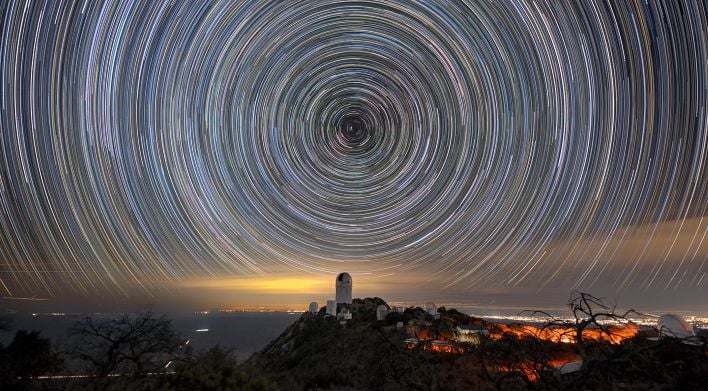
While the mission has completed its initial planned survey, the team has already tasked DESI with the next phase of observations. The plan is for the telescope to map through 2028 and expand the current dataset by 20%, from 14,000 square degrees to 17,000 square degrees (the full sky covers 41,000 square degrees). Part of the new coverage will include areas closer to the proximity of the Milky Way, where brighter stars tend to obscure distant object beyond them.





