Intel X38 Express Chipset Debuts

With today’s launch, however, the Intel desktop chipset line-up gets a new flagship. To lay the foundation for the upcoming arrival of Intel’s 45nm dual- and quad-core processors, the company is officially introducing the X38 chipset. The X38 takes all of the things that have made the P35 a success and adds a slew of new features designed to increase memory and graphics subsystem performance.

 It has been quite some time since Intel launched a desktop chipset targeted squarely at power users and PC enthusiasts. Of course, the P965 and current P35 have both been very well received by motherboard manufactures and the enthusiast community, but these chipsets were actually designed for the upper-mainstream space. In fact, the 975X Express, which launched almost two years ago, was the last desktop chipset Intel specifically marketed for enthusiasts.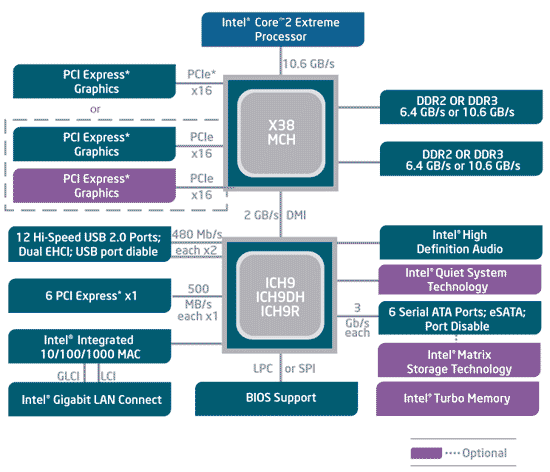
Like the P35, the X38 supports both DDR2 and DDR3 memory technologies. The X38 also supports Intel Fast Memory Access and Turbo Memory technologies and ushers in a new feature called Extreme Memory. Like EPP (SLI Memory), Intel Extreme Memory compatible modules can be detected by a supporting motherboard and the board’s BIOS will be automatically programmed to properly support the RAM. DDR3 speeds up to 1333MHz are officially supported, but through overclocking much higher speeds are possible. Intel actually claims the X38 is capable of DDR3 speed of roughly 2.13GHz.
;)
;)
With the X38 chipset, Intel will also be offering a new application dubbed the Intel Extreme Tuning Utility. The Extreme Tuning Utility is akin to NVIDIA’s nTune System Utility, which gives users access to a number of performance and overclocking related features via a Windows-based software tool. To further support the enthusiast pedigree of the X38, the chipset is designed with flexible (i.e. unlocked) bus ratios and it will eventually support 45nm processors with a 1600MHz front side bus speed.;)
;)
Perhaps the most distinguishing feature of the X38 is support for PCI Express 2.0 connectivity, with a full 16 lanes each dedicated to a pair of PCI Express x16 PEG slots. The X38 Express chipset has 32 PCI Express 2.0 lanes dedicated to graphics, whereas the P35 has only 16 PCI Express 1.0 lanes.
Many X38 boards will sport a third PCI Express x16 slot as well, but it will be outfitted with only an x4 electrical connection. PCI Express 2.0 is backwards compatible with current PCI Express 1.1 / 1.0 graphics cards, but when next-gen GPUs arrive that natively support PCI Express 2.0 arrive, PCIe 2.0 slots will offer twice the bandwidth of current solution.