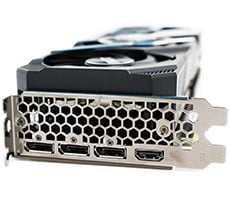
AMD ATI Radeon HD 5870: Unquestionably Number One


The Radeon HD 5800 series is also outfitted with an enhanced version of the ATI UVD 2 video engine. Although the vast majority of the features of the UVD 2 engine remain unchanged from the Radeon HD 4800 series, AMD's latest flagship does have some new capabilities...
;)
;)
;)
;)
The slides above detail the new features available with the Radeon HD 5800 series' updated UV2 engine. The Radeon HD 5800 series offers 2.0 hardware accelerates decoding of dual 1080p HD video streams, independent video gamma controls, Blue-Stretch processing for effectively brighter whites in video, and dynamic video range support. The Radeon HD 5800 series also has some new capabilities related to its HDMI output. Cards now support Dolby True HD and DTS-HD Master Audio playback, with full support for AC-3 and DTS surround sound output with up to 8 channels of 192kHz / 24-bit audio.
The Radeon HD 5800 series has also been treated to new texture filtering algorithms that removes the angle dependence of previous generations and features a new LOD management scheme that is supposed to offer higher quality. In addition, the Radeon HD 5800 series also offers new Super Sampling AA modes.
Although time did not permit us to do an in-depth analysis of the Radeon HD 5800 series image quality, we have been using a Radeon HD 5870 for a couple of weeks and can safely say in-game image quality is excellent.
|
|
|
|
;)
;)
;)
To demonstrate, we captured a few images with a Radeon HD 5870, a Radeon HD 4890, and a GeForce GTX 295. The images above were captured in Left 4 Dead's Blood Harvest map, at precisely the same perspective. The full resolution scenes are available above, with minimal JPG compression.
|
|
|
|
;)
;)
;)
We also zoomed into a couple of areas to highlight anti-aliasing and anisotropic filtering quality. Here are what the trees in the upper-right corner of the scene look like when magnified 200%. With 4x multi-sampling anti-aliasing enabled on all three cards, output is very similar. We of the opinion that the Radeon HD 5870 produces a somewhat softer image, that lacks some of the sharpness of the 4890 or GTX 295. Whether or not that is better is up to interpretation.
|
|
|
|
;)
;)
;)
Here we have some magnified images of the ground at approximately the center of the screen. Inspecting the zoomed images reveals almost no differences in the image quality between the three cards, save for some harder edges on the shrub in the Radeon HD 4890 shot.
There are a multitude of other anti-aliasing and anisotropic filtering settings and combination that could be compared and contrasted between the different cards featured here, but ultimately some of the differences are so subtle they can hardly be seen without enlarged, stills of a scene. From what we've seen so far, the Radeon HD 5870 offers excellent image quality, but the previous generation from AMD and NVIDIA do a good job too.