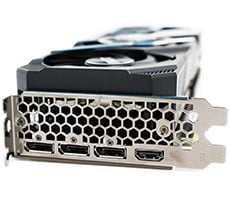
NVIDIA GeForce GTX 590: Dual GF110s, One PCB

Over the years, we have consistently been impressed by cutting-edge dual-GPU powered graphics cards, not only for their relatively high performance, but because of the engineering involved to design, build, and bring the cards to market, in form factors not much bigger than their high-end, single-GPU based counterparts. From the GeForce 7950GX2 to the GeForce GTX 295, or the Radeon HD 3870X2 to Radeon HD 6990, top of the line (for their time) dual-GPU cards have offered performance that’s head and shoulders above rival single-GPU cards of their generation. There have always been some specific issues to contend with, with dual-GPU powered cards, namely power and software support, but by and large they have been the more drool-worthy component level hardware to come through the lab.
A couple of weeks ago, we showed you AMD’s latest dual-GPU powered graphics card, the Radeon HD 6990. Sporting a pair of Cayman-class GPUs, 4GB of RAM, and foot long PCB, the Radeon HD 6990 proved to be one heck of a performer. Today, it’s rival NVIDIA’s turn to unveil their latest dual-GPU powered flagship, the brand new GeForce GTX 590.
We’ll dig into the GeForce GTX 590 in the pages ahead, but much can be deduced from the couple of pictures and specifications below. The GeForce GTX 590 is built with a pair of fully-functional GF110 GPUs, the same used on the GeForce GTX 580, each with 512 CUDA cores and 384-bit memory interface linked to 1.53GB of GDDR5 memory per GPU, for 3.07GB total. Those specs alone allude to the GTX 590’s high performance, but there’s more to the story.

The Surprisingly Sleek NVIDIA GeForce GTX 590 Reference Card
 |
|


NVIDIA's GeForce GTX 590, The Backside
In our coverage of the Radeon HD 6990 a couple of weeks ago, we said, "A lot of engineering when into designing and building the Radeon HD 6990. So much work in fact that it has spanned a few GPU generations." The same is true of the new NVIDIA GeForce GTX 590. So, with that in mind, we’d suggest checking out a few past HotHardware articles to fully grasp all of the technology that the dual-GPU powered GeForce GTX 590 has to offer. We won’t be rehashing many of the architectural details that have already been covered in these previous articles:
- NVIDIA GeForce GTX 580: A New Flagship Emerges
- NVIDIA GeForce GTX 480: GF100 Has Landed
- NVIDIA GeForce GTX 295 Unleashed
- GeForce 9800 GX2 and nForce 790i SLI Launch
- NVIDIA Quad-SLI with the ASUS EN9800GX2
- Do-It-Yourself Quad-SLI: It's Official
In our coverage of the GeForce GTX 480 and GeForce GTX 580, we go in-depth regarding the architecture and features of NVIDIA GF100 and GF110 GPUs, and its two GF110 chips which power the GeForce GTX 590. In our reviews of the GeForce GTX 295 and 9800 X2, we discuss some of the methods and technologies NVIDIA has employed in some previous dual-GPU powered offerings. If you're in need of a refresher, take some time and peruse a few of those articles, then cruise on ahead to check out the most powerful graphics card NVIDIA has released to date. By far.