NVIDIA GeForce GTX 280 and GTX 260 Unleashed


The actual GeForce GTX 280 and GTX 260 cards don't look much different than current GeForce 9800 GTX and GX2 cards, due to the shells surrounding the cards.
;)
;)
;)
Click images for full view
The GeForce GTX 280 reference card picutred here has a GPU clock of 602MHz, with a Stream Processor clock of a1,296MHz. The full 240 SP cores in the GT200 GPU are enabled, and the card sports a 1GB frame buffer consisting of 16 pieces of DDR3 memory clocked at 1.1GHz (2.2GHz DDR), connected via a 512-bit memory interface. This configuration offers a peak texturing fillrate of a 48.2GTexels/s and over 141GB/s of memory bandwidth.
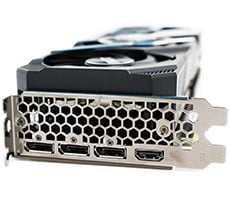
There are two dual-link DVI outputs on the card, along with an HD/TV output. HDMI with audio is supported through the use of an adapter, and audio signals can be passed through the card by way of an SPDIF input, similar to the one found on the 9800 GTX and GX2. HDCP is supported as well.
The GeForce GTX 280 required both a 6-pin and an 8-pin PCI Express power connector and max board power hovers around 236 watts.

;)
;)
Click images for full view
As we've mentioned, the new GeForce GTX 260 is essentially the same as the GTX 280, sans a couple of thread processor clusters and memory partitions. The GT200 GPU used on the GTX 260 has 192 stream processors enabled. The GPU is clocked at 576MHz on the reference card, with a 1,242MHz stream processor clock. 866MB of on-board DDR3 frame buffer memory is clocked at 999MHz (1.99GHz DDR), connected to the GPU over a 448-bit interface. The GeForce GTX 260 offers a peak texturing fillrate of 36.9GTexels/s with 111.9GB/s of memory bandwidth.
The output options are the same on the GTX 260, but power requirements are more modest. The GeForce GTX 260 requires two 6-pin PCI Express power connectors and has a max power of 182 watts.
Something you don't see in these pictures (but you will see on the next page) is that both the GeForce GTX 260 and GTX 280 sport of pair of SLI edge connectors and both support two-card and three-way SLI configurations.