Lenovo IdeaCentre Y710 Cube Review: Big Gaming Performance In A Small Package

Some noise is to be expected from a gaming PC, but too much will make you regret your purchase. We listened intently to the Lenovo IdeaCentre Y710 Cube throughout the review process to monitor noise levels. We also used a power meter to monitor the power draw.

Total System Power Consumption
Measured At The Outlet

The Y710 Cube features a 450W power supply, a relatively mainstream CPU and only a single GPU, guaranteeing that the system will draw less power than many of the larger, multi-GPU PCs we’ve tested recently. We recorded the Cube’s power draw when idle and under heavy load for comparison.
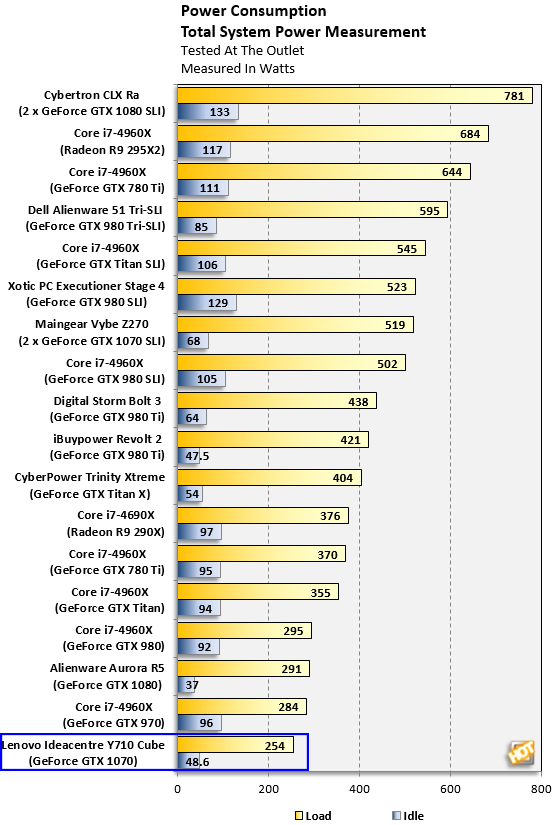
power consumption

Even under heavy load, the Y710 Cube proved to have a light touch. It pulled just 254W when fired up. At idle, the Cube had one of the lightest draws, at 48.6W. That put it in the neighborhood of another SFF, the iBuypower Revolt 2. The Alienware Aurora R5 managed the lowest idle draw at 37W.

Noise: Because the CPU has a large cooler, crammed into a small space, we expected the Y710 Cube to be fairly loud. As it turned out, the system is quiet overall. It’s nearly silent when idle, with just a soft hum from the CPU fan escaping the system. Fire up a video game, and the Cube responds with more fan noise, but even then, we didn’t find ourselves needing to reach for our headphones.

Joshua Gulick

Joshua Gulick

Josh cut his teeth (and hands) on his first PC upgrade in 2000 and was instantly hooked on all things tech. He took a degree in English and tech writing with him to Computer Power User Magazine and spent years reviewing high-end workstations and gaming systems, processors, motherboards, memory and video cards. His enthusiasm for PC hardware also made him a natural fit for covering the burgeoning modding community, and he wrote CPU’s “Mad Reader Mod” cover stories from the series’ inception until becoming the publication editor for Smart Computing Magazine.  A few years ago, he returned to his first love, reviewing smoking-hot PCs and components, for HotHardware. When he’s not agonizing over benchmark scores, Josh is either running (very slowly) or spending time with family. 

Related content