Asus ARES Dual Radeon HD 5870 4GB Review


As we've mentioned, inside the gigantic Asus ARES retail box resides a locking, metal briefcase that holds the card itself and all of the accessories included with it. While the size is a bit much, the overall presentation is definitely that of an ultra-high-end, enthusiast product.
;)
;)
Cracking open the brief case reveals a number of items; the ARES card (obviously), a pair of dual 6-pin to 8-pin PCI Express power adapters, a DVI to HDMI adapter, a CrossFire bridge connector, a case badge, driver discs, and users manuals. In addition, Asus also throws in a Republic of Gamers branded gaming mouse, with adjustable DPI settings and customizable buttons.

Getting down to the nitty-gritty, the Asus ARES is a unique sort of beast. The card is massive and quite heavy. The PCB measures 11.5" by 5" and the large cooling solution will cover three expansion slots. A finned aluminum heatsink adorns the backside of the PCB, to cool half of the RAM. Another aluminum heatsink covers much of the front of the card, to cool the power regulation circuitry and remaining RAM, and two large all-copper heatsinks with think, 8mm heatpipes take care of the two Cypress XT (Radeon HD 5870) GPUs. In the middle is a large 100mm cooling fan. And covering the whole assembly is a black and red aluminum shroud.
;)
;)
;)
;)
As you can see, the Asus ARES is a biggun'. And it requires three power connectors--two 8-pin, and one 6-pin. The shebang weighs in at around 5lbs, so securely screwing the card in place is paramount--the plastic, tool free hold downs on some cases aren't going to cut it.
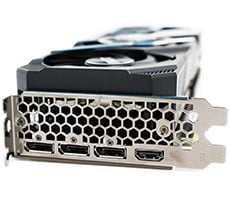
Outputs on the ARES card consist of a single dual-link DVI output, an HDMI output and a DisplayPort output. The ARES obviously is a great candidate for Eyefinity due to its sheer horsepower, but note that it's limited to three screens due to its output configuration. and because one of those outputs is HDMI, the maximum Eyefinity resolution will be limited to 3 x 1920x1200.