AMD ATI Radeon HD 5850 Performance Review


The new ATI Radeon HD 5850 is a significant step up from the Radeon HD 4870 which launched last year, but not quite as powerful as AMD's current flagship Radeon HD 5870. The chart below illustrates exactly how the cards compare in a number of key categories.
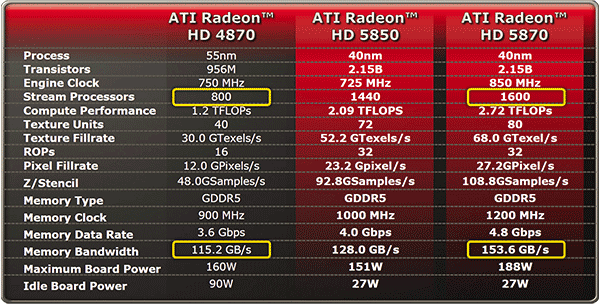
Radeon HD 4870, Radeon HD 5850, and Radeon HD 5870 Comparison
As you can see, the Radeon HD 5850 is outfitted with the same 2.15B transistor GPU manufactured at 40nm as the Radeon HD 5870, but the GPU is clocked at only 725MHz, and is outfitted with 1440 stream processors, which results in 2.09TeraFLOPS of compute performance versus the 5870's 2.72TeraFLOPS. The Radeon HD 5850 also sports eight fewer texture units than the 5870, but the same number of ROPs. Finally, the 5850's memory clock is reduced to 1000MHz (4Gbps data rate), which results in 128GB/s of peak bandwidth.
The aggregate effect of all of the changes made to the Radeon HD 5850 result in a graphics card with a 52.2GTexels/s texture fillrate (23.2Gpixels/s), that's still capable of breaking the 2TeraFLOP mark in terms of compute performance. The changes made to the Radeon HD 5850 result in lower power consumption too, as is evident by the card's 151W max board power, which is actually 9 watts lower than the previous generation Radeon HD 4870.
;)
;)
From the front, the Radeon HD 5850 looks very much like the Radeon HD 5870 that launched last week. Although, as we have already pointed out, the Radeon HD 5850 has a shorter PCB; 9" to be exact. Both cards are equipped with a black fan shroud, with a red stripe running down the middle, that encases the entire front side of the card. Like the 5870, the 5850's cooler has a barrel fan that draws air into the shroud, where it is forced through the heatsink and partially exhausted from the system through vents in the card's mounting plate. Two more vents at the back of the card also direct some air that is vented within the system.
The outputs on the Radeon HD 5850 consist of dual, dual-link DVI outputs, an HDMI output (with audio) and a DisplayPort output. Any combination of three of these ports can be used, and of course the card fully supports the ATI Eyefinity multi-display technology.
;)
;)
Unlike the Radeon HD 5870 though, the backside of the Radeon HD 5850 is exposed. Other than the myriad of surface mounted components, however, there isn't much to see. The GPU heatsink retention bracket is visible right about in the center the PCB, with the card's dual CrossFire edge connectors a couple of inches away at the top corner, just like every other Radeon since the X1950.
As we've mentioned, total board power is rated at 151 watts. As such, the Radeon HD 5850 requires a pair of 6-pin PCI Express power connectors--no 8-pin connection is required, like some other higher-powered boards.