


Windows 11's New Security Check Could Let Game Makers Block Your PC


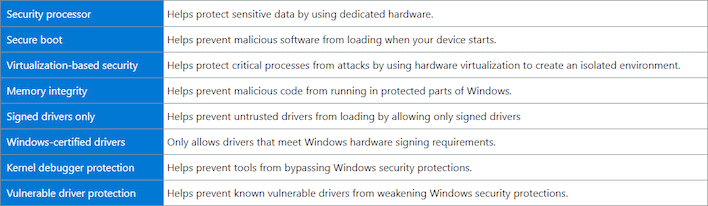
The initial baseline requires eight conditions to be satisfied, including Secure Boot, a security processor, VBS, Memory Integrity, signed and Windows-certified drivers, kernel debugger protection, and vulnerable driver protection. If every requirement is met, the system reports that baseline protection is active. If even one requirement isn't met, the answer is no. Microsoft is also providing developers with an API and cryptographically verifiable attestation tokens, allowing applications and remote services to independently verify a machine's security status.
Microsoft is explicitly encouraging developers to replace their existing, individual security checks with this new baseline signal. Its own announcement gives examples of games checking driver signing, financial applications checking for a TPM, and examination software verifying Secure Boot. Rather than maintaining these checks independently, developers are encouraged to simply ask Windows whether baseline protection is active. Microsoft emphasizes that developers remain free to decide what to do with the result. They can allow access, issue warnings, restrict functionality, or refuse to run entirely. The platform reports the state; the developer owns the policy.

Technically, that's true, but I think it misses the forest for the trees; just consider the implications for software developers. An independent security assessment requires engineering resources, maintenance, compatibility testing, and an understanding of the actual security requirements of the application. Microsoft's new API offers a considerably cheaper alternative in one standardized query that effectively outsources much of that work to the operating system vendor. Why bother maintaining an independent assessment when Microsoft has already done the work for you?
The problem is that Microsoft's baseline doesn't necessarily represent the security requirements of any particular application; instead, it represents Microsoft's preferred security configuration for Windows, and those aren't the same thing. A game developer might have legitimate reasons to require TPM functionality and Secure Boot without requiring VBS or prohibiting kernel debugging. A developer working with specialized hardware might have equally legitimate reasons to use test-signed drivers. These are configuration decisions that should be evaluated according to the actual security requirements of the software in question.
Instead, developers are being encouraged to substitute Microsoft's entire collection of requirements for their own judgment, and the consequences could be significant. As more applications adopt this standardized signal, users will increasingly find themselves required to maintain Microsoft's preferred configuration simply to continue using software that previously had no such requirements. Nobody has technically mandated that users enable these protections, but the practical consequences of disabling them could become increasingly prohibitive.
There's another consideration, too, in that Microsoft explicitly describes the initial baseline as a floor rather than a ceiling. Requirements will evolve, with additional protections introduced as the security landscape changes. The baseline is versioned, meaning that the definition of an acceptable Windows security configuration can change over time, and this creates an interesting dependency. Developers who outsource their security assessments to Microsoft also outsource the evolution of those assessments. Microsoft changes the baseline, and applications that rely on it can effectively inherit those changes without their developers ever independently deciding that the new requirements are necessary.

I don't necessarily believe this is a deliberate attempt by Microsoft to restrict user autonomy. Microsoft has a rather long history of different divisions pursuing objectives that don't always appear particularly coordinated, to put it delicately. I suspect institutional convenience and the desire to standardize security practices explain much of this initiative, but intentions are, as always, beside the point. The architecture creates incentives that push the entire Windows ecosystem toward a single, vendor-defined security configuration.
I have no objection to Microsoft recommending security practices, providing better security tools, or offering hardware-backed attestation. I also have no objection to individual software vendors establishing their own security requirements, even when those requirements are restrictive. What I object to is the gradual conflation of Microsoft's preferred security configuration with the definition of a trustworthy computer.
For the record, I'm not picking on Windows; I don't approve of this same thing on smartphones, either. The truth is that a computer doesn't become inherently insecure simply because its owner has chosen a different configuration from the default. An administrator might deliberately disable Secure Boot, use unsigned development drivers, enable kernel debugging, or establish an entirely independent root of trust. Those decisions may introduce risks, but they don't automatically constitute a security failure.
I believe ownership should mean something. If I purchase a computer, I should retain the authority to administer, modify, and configure it as I see fit. Software vendors should retain the right to establish their own trust requirements, and users should retain the right to choose which software they run. Windows Baseline Protection risks these rights, not by explicitly taking administrative control away from users, but by making the exercise of that control increasingly inconvenient and potentially incompatible with the software ecosystem. Even assuming the best of intentions, I don't think Microsoft has thought this one all the way through.