



Will A Steam Deck 2 Still Happen? Valve Reveals Key Requirement


Valve is releasing a handful of new gaming hardware, including an updated Steam Controller, a standalone VR headset called Steam Frame, and the return of the Steam Machine, this time in a compact cube design that's unofficially been dubbed the GabeCube (a play on words between Gabe Newell and Nintendo's GameCube). The obvious question in light of all this new hardware is where do plans stand for a Steam Deck 2 handheld, and Valve addressed the topic in an interview with IGN.
"Obviously the Steam Deck's not our focus today, but the same things we've said in the past where we're really interested to work on what's next for Steam Deck… the thing we're making sure of is that it's a worthwhile enough performance upgrade to make sense as a standalone product," software engineer and SteamOS developer Pierre-Loup Griffais told the outlet.
He goes on to state in no uncertain terms that there are "no offerings" in the current system-on-chip (SoC) landscape that excite Valve enough to build a next-generation handheld around. For context, Valve says its reborn Steam Machine, which is based on an semi-custom chip with a 6C/12T Zen 4 CPU and 28 RDNA 3 compute units, is "over 6x more powerful than Steam Deck."
While compact in its own right—the Steam Machine is basically a mini PC measuring 152mm tall (148mm without the feet) by 162.4mm deep by 156mm wide—it's an apples to orange comparison. So the next obvious question would be, how much faster does the silicon need to be to justify moving forward with a Steam Deck 2?
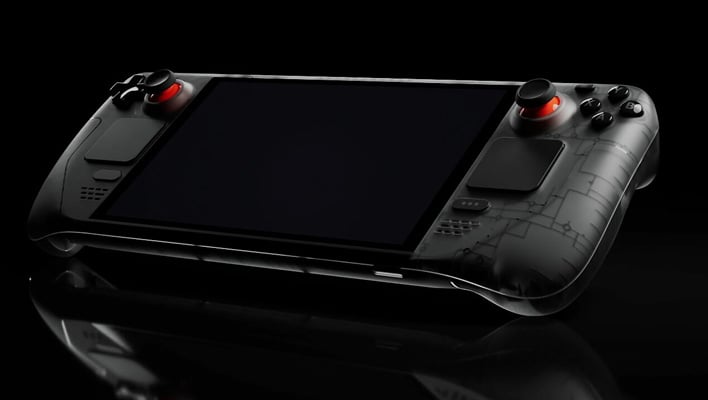
Griffais alluded to the answer in the same interview.
"We're not interested in getting to a point where it's 20 or 30 or even 50% more performance at the same battery life. We want something a little bit more demarcated than that. So we've been working back from silicon advancements and architectural improvements, and I think we have a pretty good idea of what the next version of Steam Deck is going to be, but right now there's no offerings in that landscape, in the SOC landscape, that we think would truly be a next-gen performance Steam Deck," Griffais said.
Simply put, Valve needs the performance jump to be north of 50% while maintaining the same or better battery life compared to the current-generation Steam Deck. And right now, Griffais and the gang at Valve don't see anything out there that meets its criteria.
It's a markedly different approach than the one Nintendo has taken. The Switch 2 is indeed a decent upgrade over the Switch 1 in terms for performance and capabilities, but not necessarily leaps and bounds ahead. Historically, Nintendo has managed to compete in the gaming hardware space without pushing the envelope or releasing the fastest hardware on the block. It's a luxury that its strong IP and understanding of what makes a game fun, that affords Nintendo that luxury. Case in point, the Swtich 2 is the biggest console launch in history.
The good news is, Valve certainly sounds committed to eventually releasing a Steam Deck 2. Valve has shared that sentiment multiple times before. But with the market for PC gaming handhelds have grown exponentially since the Steam Deck's release, as well as Valve's new hardware barrage, it's fair to wonder if that's still the case.
As for timing, a rumor from around two and half months ago claims a Steam Deck 2 is being targeted for a 2028 release, though that hasn't been substantiated by Valve.




