



New Data Shows Universe Is Expanding Faster Than Thought, Scientists Baffled


To determine how fast the universe is growing (i.e. the Hubble constant value) astronomers typically measure the brightness of specific stars, like Cepheid variables, and stellar explosions, known as Type Ia supernovae, to calculate distances to nearby galaxies. The new study, published in Astronomy & Astrophysics by the H0 Distance Network (H0DN) collaboration, utilized data from NSF NOIRLab telescopes and HST to pin this local expansion rate at 73.5 kilometers per second per megaparsec, with a precision of about 1%.
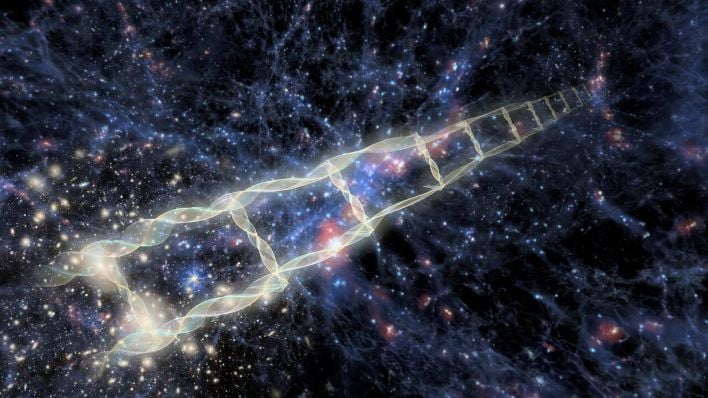
The problem arises when this number is compared to predictions derived from the Big Bang echo, also known as the cosmic microwave background (CMB). When scientists look at the state of the early universe from 13.8 billion years ago and use our standard model of physics to project forward to today, they get a significantly lower expansion rate of roughly 67 kilometers per second per megaparsec.

This persistent mismatch suggests that the standard Lambda Cold Dark Matter (ΛCDM) model might be incomplete. If the math is right but the numbers don't match, it implies there is a physical process at work that we haven't yet identified. This new physics could involve exotic forms of dark energy that change over time, a new type of subatomic particle in the early universe, or even a misunderstanding of how gravity behaves at a cosmic level.
While the mystery remains unsolved, the precision of the H0DN study provides a rock-solid foundation for the next generation of observatories. Facilities like the Vera C. Rubin Observatory and the Nancy Grace Roman Space Telescope will soon provide even deeper datasets, potentially revealing what exactly is outrunning our best theories on this matter so far.





