



Lexar Says Gamers Would Rather Skimp On RAM Than Settle For A 512GB SSD


Would you rather settle for having less DRAM in your PC or less solid state drive (SSD) storage? It's a fair question in today's landscape, and according to Lexar, most gamers are more inclined to skimp on system memory versus skimping on SSD storage, based on an evaluation of its sales data versus its sales forecast for both types of products.
It's all relative, of course, but the interesting takeaway is that gamers are rejecting 512GB capacity SSDs, as sales of 512GB and smaller storage drives ended up being just a fraction of what it was anticipating. Meanwhile, sales of smaller capacity PC DRAM kits and memory cards were right about where Lexar thought they would be.
That's according to what Lexar Europe General Manager Grace Su told Digital Foundry's William Judd during a recent media tour of the company's facilities in Shenzhen, Suzhou, Zhongshan, and Shanghai. Su says "the end user just doesn't buy" SSD capacities less than 1TB these days, as both users and retailers are content to bide their time with what they currently have while the market reels from an AI-driven chip shortage.
Perhaps even more surprising, some users would prefer to go back to mechanical hard disk drives (HDDs) rather than pay inflated pricing for SSDs, according to Su. Incidentally, HDDs are not immune to the AI data frenzy, either.
This is the plight of the modern day gamer, and there's little escaping the ripple effect. Hopping over to consoles is one option, but both Sony's PlayStation 5 and Microsoft's Xbox Series X|S have seen rounds of price hikes, not to mention both being towards the end of their generational lifecycle.
Those sticking to the PC platform, meanwhile, have to contend with skyrocketing memory and storage prices, and GPUs that, at the higher end, routinely sell for more than the baseline MSRPs set by AMD and NVIDIA. Even so, are gamers truly willing to shun 512GB SSDs while accepting smaller memory kits?
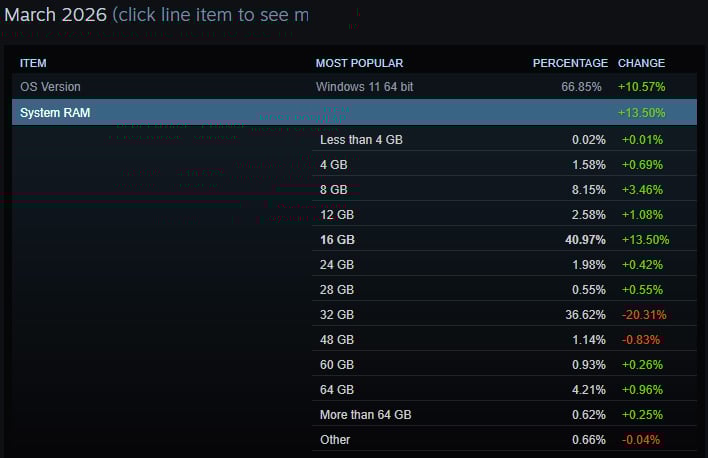
We took at peek at Valve's latest Steam hardware survey and found some interesting results. Looking at the memory breakdown, of those surveyed, 40.97% have 16GB of RAM and 36.62% have 32GB, which collectively accounts for over three-fourths of the participants. Those with 12GB or less were all in the single-digits (percentage-wise), including 8.15% of systems pinged showing 8GB of RAM.
On the storage front, half of all participants have more than 1TB of total storage (50.11%), 23.61% have 750GB to 999GB, 2.41% have 500GB to 749GB, 17.79% have 250GB to 499GB, and 5.83% have 5.83GB. All capacities lower than 100GB tally less than a quarter of a percent.
While the DRAM data is a little murky, Lexar's assessment of storage appears to be line with Steam's latest survey results. That said, Steam's surveys are an imperfect snapshot of the landscape as they do not represent all Steam users, but they're still one of the best resources for getting a pulse of gaming hardware (and software) trends.




