



Invisible Terahertz Tech Watches Your CPU Cycles, Sparking Data Theft Fears


Even according to Withawat Withayachumnankal, Professor of Engineering at Adelaide University and group leader for the research, "It requires line-of-sight, but it can penetrate chip packaging materials that are non-metallic." Additionally, "It's not clear that all these layers [within modern chips, ie Ryzen X3D CPUs] are all transparent to terahertz radiation. If those over-layers are opaque, then this technique cannot be used to diagnose that deeply buried device. That's the limitation of the idea."
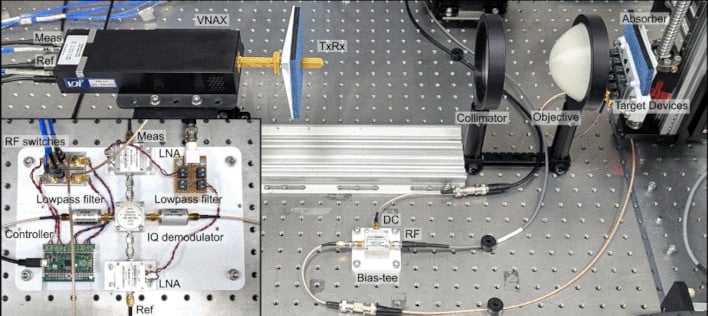
A lot of hardware is required for terahertz monitoring.
So in short, are the data theft fears tied to this technology warranted? Not really. This is high-end stuff best used for chip testing and manufacturing. Governments and cyber criminals have far easier, better ways to exfiltrate data from your devices than terahertz monitoring. While it is very cool to learn that CPUs can be physically monitored to this extent, there are far more dangerous cyber attacks already here or on the horizon, ranging from unkillable rootkits to quantum encryption breaking to classic phishing schemes.
The real breakthrough here is for existing semiconductor testing and manufacturing, where existing imaging techniques like electronic probing or X-ray inspection can only produce imagery of a chip's structure, not observe its electrical behavior. The long-term implications of that are difficult to quantify at such an early stage, but it could lead to improvements in fault tolerance and engineering for next-generation chips.
The original paper and statements from researchers on IEEE Spectrum provide more detail on how it's done and where it could go once "refined and perfected," especially for "safety-critical applications such as high-power electronics, where devices cannot easily be taken offline without operational disruption."




