


Intel Razor Lake CPU Leak Points To 12 P-Cores With Big Cache To Rival X3D



While that's the story, that's not the really fascinating part of this product. According to Jaykihn while clarifying things for commenters on Xwitter asking specific questions, this is twelve Coyote Cove P-cores on a single compute tile with no E-cores on the tile. Furthermore, this tile will apparently be fabricated by Intel itself on its own 18A-P fabrication process. All of this is exceedingly unusual.
For starters, Intel has never made a compute tile for a consumer CPU with more than 8 P-cores on it. (The Bartlett Lake 12-core chip is monolithic.) It has also never released a high-performance consumer CPU with zero E-cores; the closest we've come is probably Lunar Lake, which has 4 P-cores and 4 LP E-cores. This chip still has LP E-cores, but those cores are expected to be on the SoC tile, not on the compute tile.
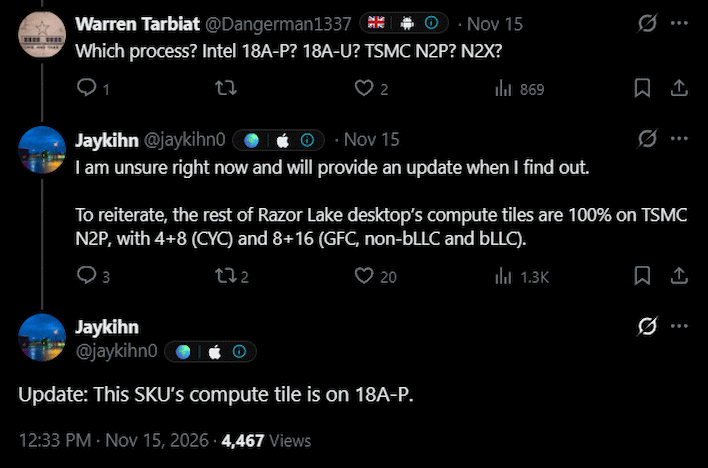
Furthermore, the same leaker reinforced that all other Razor Lake compute tiles, including a familiar 8+16 version as well as a 4+8 tile, will be manufactured at TSMC on that firm's N2P process. The choice of in-house 18A-P manufacturing is a fascinating one considering that Diamond Rapids Xeon 7 processors will probably take up the majority of 18A-P fabrication capacity.
Finally, the specific use of Coyote Cove P-cores is itself interesting because that is expected to be the P-core design for Nova Lake, not Razor Lake. While some Razor Lake processors are thought to be refreshed Nova Lake silicon, it has been leaked by both Jaykihn and others (MLID) that some Razor Lake processors will use Griffin Cove P-cores. Jaykihn specifically has stated that the aforementioned 4+8 tile will use Coyote Cove, while the 8+16 tile will use Griffin Cove. It's not clear yet what the differences in the two P-core designs are, nor how either differs from the extant Lion Cove P-cores.

So this new product appears to be a twelve-core desktop CPU with an extra four LP E-cores that can probably be disabled to guard against scheduling SNAFUs. Thanks to 18A-P, it should be exceptionally efficient, and thanks to bLLC, it should have outstanding gaming performance. Intel's Arrow Lake already beats Zen 5 rather handily in terms of single-threaded performance, but we now know Zen 6 has a considerable IPC uplift over the previous gen, and may also have a tremendous boost in clock rates, too.
It'll be a fascinating battle to be sure. Nova Lake and Zen 6 processors are both expected to launch within the next 3 months, while Razor Lake (including the topic of today's post) isn't expected until 2028.