



Leaked Intel SoC Plan Pairs x86 CPUs With NVIDIA RTX Integrated GPUs In Early 2028


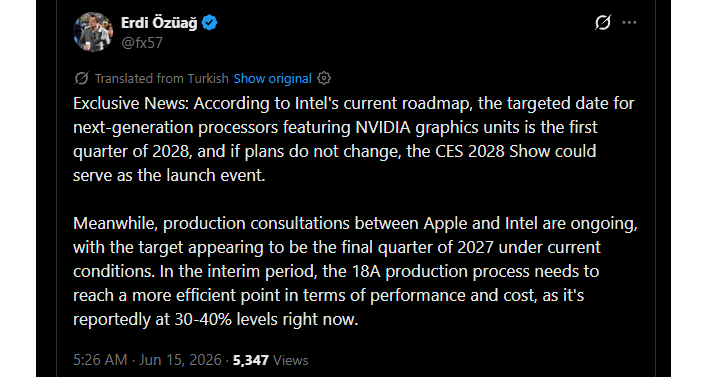
We've actually heard that these parts would be coming in 2028 before; according to other leakers, the chips that match Intel CPUs and manufacturing with NVIDIA GPU chiplets would be part of the Titan Lake family, and may potentially be code-named Serpent Lake, although newer leaks have cast doubt on that name by suggesting that it may be a misnomer or potentially a codename used only for the chips with NVIDIA GPU chiplets. The latest we heard is that these Titan Lake parts would be launching in 2028, but the new leak specifically notes CES 2028 as the launch window for these parts.
So what are they going to be? Well, based on what we've seen, Titan Lake appears to be a mobile-only chip family. It will bring new disaggregated tiles for compute, I/O, and graphics, but the specific processors that will use NVIDIA graphics apparently carry forward the CPU ("Compute") tiles from the previous-generation Razor Lake family, which is expected to succeed Nova Lake. Intel's roadmaps seem to describe two variants of the "Titan Lake B-Package", which will seemingly include memory on the processor package, like Intel's extant Lunar Lake CPUs.
Interestingly, the other Titan Lake processors are said to use a unified core architecture called "Copper Shark," where there's still P-cores and E-cores, but they share the Copper Shark architecture. That's similar to AMD's processors that have "standard" and "dense" cores on the same die, like the Ryzen AI 300 series as well as the SoC in the Steam Machine. With that said, the Titan Lake parts with the NVIDIA GPU tiles, due to reusing the Razor Lake CPU tiles, won't benefit from the new design and will supposedly still have separate P-core and E-core architectures.

We have to admit, we're curious about these new Intel SoCs with NVIDIA GPUs, but it's not completely clear why Intel would want such a thing. They'll almost assuredly be more compelling than NVIDIA's own RTX Spark—the x86 software ecosystem is simply superior to Arm for consumer products—but Intel has its own completely competent Xe graphics IP, and it's not yet clear that there is a market in consumer products for oversized SoCs with powerful integrated graphics, like the AMD Ryzen AI Max processors. The combination of Intel's strong single-threaded performance with NVIDIA's software ecosystem (CUDA, etc) could make for compelling local AI workstations to be sure, but it's not necessarily clear that the market wants that.
The best theory we've heard concerning this collaboration is that it's actually a prelude to a larger cooperative effort between NVIDIA and Intel. You see, it's not known who will fabricate the NVIDIA GPU chiplets used in the Titan Lake/Serpent Lake processors. It could be Intel itself. If that's the case, then it's possible this is a test run to determine if NVIDIA will select Intel for fabrication of future products, including, potentially, NVIDIA's Feynman AI GPUs or the GeForce RTX 60 series graphics cards. That doesn't clear up the matter of who would buy these products, but it does shine a much more favorable light on the tech titan team-up than we've seen before.
Still, these chips are more than a year and a half away at least, so speculating on their value proposition is likely a tremendous waste of time at this point. Let us know in the comments below what you think about an Intel CPU with NVIDIA RTX integrated graphics.





