



Intel Nova Lake 16-Core CPU Allegedly Packs A Beastly 40W Xe3P iGPU


Intel hasn't released a graphics-focused desktop processor since the beloved (but not for its graphics) Broadwell-C family back in 2015. Since then, AMD has completely cornered the market for budget desktop gaming and SFF PC builds with the socketed Ryzen G series APUs, like the Ryzen 7 8700G that I'm particularly fond of (it's the same APU I used to review Biwin's Black Opal DW100 memory). We've reported before on Jaykihn's claims that Intel is bringing such a chip to the LGA 1954 socket with the launch of Nova Lake, but the part and its purpose have come into much sharper focus with new details today.
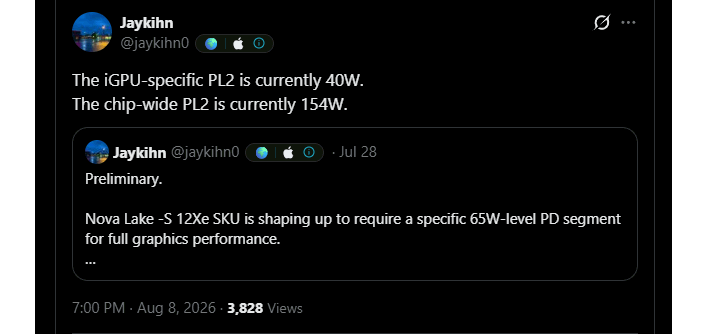
Here's the new information: the maximum turbo power of the integrated GPU is apparently 40 watts, which is significant. Also, the maximum turbo power of the whole chip, at least out of the box, is 154W. While 40 watts might not seem like a lot of power for a graphics processor, remember that this is an integrated part, meaning that that power limit is strictly for the compute and raster engine, not including the memory or its controller. It's also for a GPU fabricated on Intel's cutting-edge 18A process, which is insanely efficient.

Along with the details on power limits, Jaykihn also says that the integrated GPU on these special 12-Xe-core socketed CPUs will feature a massive 20-megabyte L2 cache. Again, that's strictly for the GPU. This is up from 16MB in Panther Lake; the extra capacity means that the GPU can work on larger frame buffers without having to dip out to system memory, which is an order of magnitude slower.
Combining the 40W power limit and the 20MB L2 cache, we should easily see the fastest integrated GPU that Intel has ever shipped, and it may just be competitive with AMD's Ryzen AI Max and NVIDIA's RTX Spark families in selected workloads. In any case, it should easily be more power efficient than either, given its use of a newer fabrication process and extensive local caching.
An Oddity Of A CPU
What's bizarre is that this is a socketed processor. In terms of structure, it looks like a mobile chip; in fact, it's nearly identical to the current-generation Core Ultra "X" series processors, like the Core Ultra X9 388H that we've tested in a few machines already. It's not that unusual to see mobile chips in desktop systems, like the various mini-PCs we talk about occasionally; indeed, that's exactly what the Ryzen AI Halo and NVIDIA DGX Spark are. However, as we noted in the beginning, Intel hasn't launched a mobile chip on a desktop socket in more than a decade, so this is a very interesting play.Our guess is that there are a couple of different impetus here. Intel might be targeting the budget gaming market, which has sadly more or less been priced out of discrete GPUs. If this chip is relatively affordable, it could make a pretty decent gaming experience for people who want to build a gaming PC but can't (yet) acquire a discrete GPU. I've recommended AMD "G" series APUs for just this reason before. But also, these parts could simply be intended for a more specific non-gaming use case or even a specific customer. The budget gaming use case also becomes a bit shaky if fast DDR5 memory doesn't come down in price.

The really odd part is that, if you recall, Jaykihn already revealed that these chips require specific motherboards to reach full performance. More accurately, there's a specific motherboard market segment meant specifically for these chips, and it has a second power phase for the graphics. There's nothing stopping motherboard vendors from wiring up that phase on higher-end boards, but it's possible that the system firmware will restrict graphics performance unless the CPU is also constrained to its 65W power level, in which case your fancy overclocker motherboard becomes a fairly silly place to install one of these CPUs.
So we have desktop Nova Lake CPUs with big integrated GPUs that only work properly in specific motherboards despite reportedly sharing the same socket as the rest of the Nova Lake family. Other lower-end and mainstream Nova Lake chips will likely work in these boards, but given the 65W PL1, they're not going to be compatible with the high-end "K" series or dual-compute-tile variants, and as we said, these chips will likely work in other Nova Lake boards, but most likely with reduced iGPU performance, in which case... what's the point?
It's a peculiar product. By straddling the line between mobile silicon architecture and desktop sockets, Chipzilla has engineered a fascinating technical anomaly: a high-powered APU shackled by motherboard market segmentation and memory bandwidth bottlenecks. Unless you happen to fall into the hyper-specific subset of DIY builders looking for a mid-tier desktop chip that requires a budget motherboard to unlock its expensive graphics tile, this particular processor oddity risks becoming an exercise in consumer confusion rather than a practical market disruptor. Hopefully, the price is right, and Intel's new 12Xe Nova Lake CPUs become cool rather than confounding.





