



Intel’s Nova Lake Next-Gen LGA-1954 Socket Spotted At Computex


If you're lost, check this out: instead of the Pin Grid Array (PGA) sockets of the past, all current-generation CPUs use "Land Grid Array" or LGA sockets. LGA has tons of advantages over the older PGA style: denser pins, better electrical performance, more durable CPUs. However, it requires very precise compression force to make sure the CPU and socket contact each other securely, and that's why we use ILMs, or as AMD calls them on Socket AM5, SAMs.
Intel's next-generation Nova Lake processor family is expected to include models with as many as 52 CPU cores. This will, obviously, require unprecedented amounts of socket power; an earlier leak stated that top-end Nova Lake parts will feature a short-period boost power limit of 471W. Carrying hundreds of amps across extremely tiny contacts is a very quick way to start a fire, so the contact between the landing pads on the bottom of the CPU and the pins in the CPU socket absolutely has to be secure. Thus, enter the "2L-ILM".
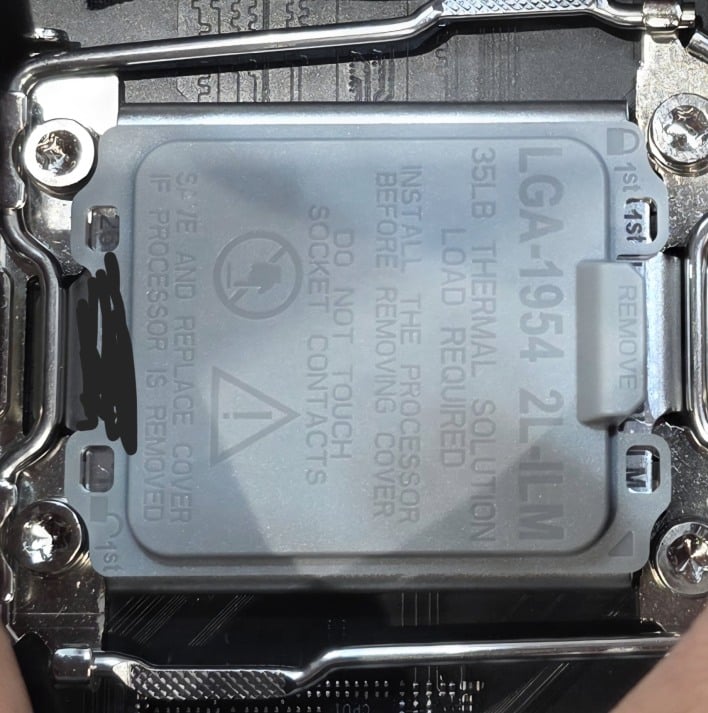
Benchlife wasn't allowed to photograph the CPU socket of the probably-Z990 motherboard that it saw at Computex, and we suspect that this is probably why. This photo comes from "LC Tech Leaks (And News)" (@laurentschoice on Xwitter), who says that it depicts "LGA 1954 at an unknown location somewhere in Taipei." In other words, he convinced some poor booth staffer to let him snap a quick photo of the Nova Lake socket and its unusual dual-arm ILM and then carefully cropped the picture to remove any identifying marks so no one got in trouble.
So what's up with the 2L-ILM? Well, as we discussed above, it could very well be to ensure that the CPU is held securely in the socket to avoid any issues with the high power draw of the top-end Nova Lake chips. But it also could be due to the aforementioned CPU bending issue. The RL-ILM worked to avoid that problem, but as a result of the reduced load, it required a CPU heatsink with a certain amount of mounting force to ensure that there were no connection issues between the CPU and the pins.
Intel may have simply decided to take matters out of the DIY builders' hands and design a new ILM that both applies load more evenly and applies more load to ensure solid contact. However, because the protective cap is still on the socket, and because of the "35LB Thermal Solution Load Required" note on said cap, we really can't be sure. It will be interesting if these new ILMs appear on all Nova Lake motherboards or just higher-end models, and similarly, we wonder if the top-end Nova Lake parts with dual compute tiles will actually work properly in a motherboard without a 2L ILM.





