



Intel Nova Lake Leak Points To Monster 65W Xe3p iGPU Power Delivery


Jaykihn claims the preliminary specs for this 12-Xe-core desktop chip demand a dedicated "65W-class power delivery segment" to reach full graphics performance, and that it's the only Nova Lake desktop processor that requires two VCCGT power phases. For the unfamiliar, VCCGT is the motherboard voltage rail dedicated to the integrated graphics. Mainstream desktop CPUs usually don't stress this part of the VRM because their iGPUs exist mainly to drive displays and provide media acceleration. Demanding two VCCGT phases implies this rumored Nova Lake part is a rather different animal.
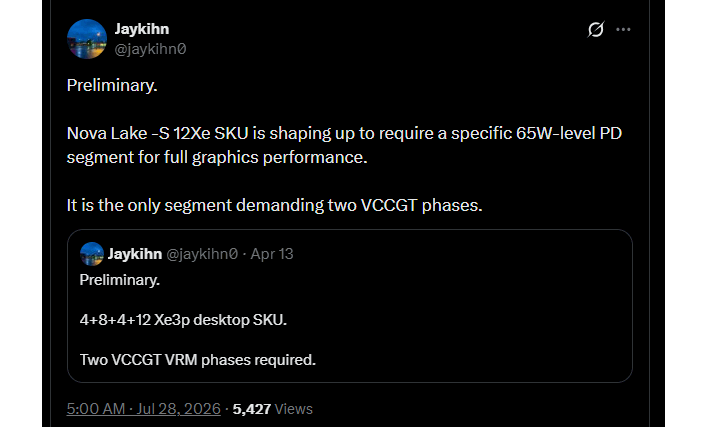
Jaykihn's wording leaves room for interpretation. "65W" could simply refer to the processor's overall 65W TDP class. That would fit given its rumored layout: 4 Coyote Cove P-cores, 8 Arctic Wolf E-cores, and 4 low-power E-cores, paired with that massive GPU tile. The Arc G3 Extreme, with just two fewer P-cores, is reasonably comfortable at 35W, so 65W with a pair of extra P-cores and raised clocks would fit nicely. Alternatively, Intel could be referring specifically to a 65W power rail for the GPU itself, but two phases for 65W would be pretty slim, making this the less likely reading.
While AMD has long been comfortable repurposing its mobile silicon for desktop APUs, Intel usually treats desktop integrated graphics as an afterthought. The closest historical parallel is probably the Broadwell-based Core i7-5775C, which paired capable Iris Pro graphics with 128MB of eDRAM and earned a cult following as a result. Nova Lake appears to be taking a different approach by slapping a dramatically larger Celestial (Xe3p) GPU tile onto a fairly standard desktop CPU.
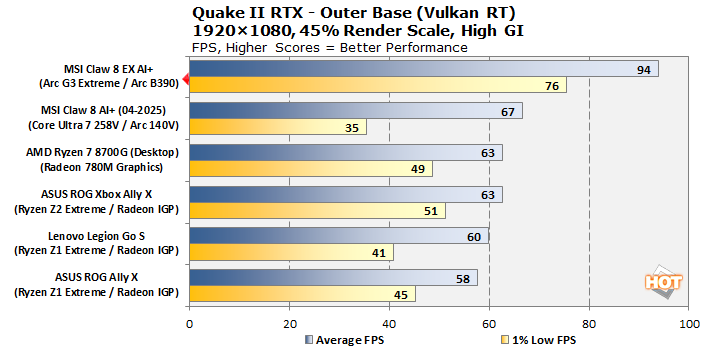
We already know Intel's latest graphics architecture is no joke. We've tested Panther Lake's Arc B390 graphics in multiple laptops already, and the same chip powers the Arc G3 Extreme in the MSI Claw 8 EX AI+. In all cases, Intel's Xe3 iGPUs have proven capable of serious gaming. With consumer discrete Celestial graphics cards reportedly canceled in favor of AI hardware, this unusual desktop SKU might be one of the few ways PC enthusiasts can actually experiment with the Celestial architecture in a gaming context.
One consideration is that if this chip uniquely requires a second VCCGT phase, not every LGA 1954 motherboard will run it at full capacity. Budget boards with a single-phase VCCGT VRM might limit boost behavior, cap graphics clocks, or simply be altogether incompatible. Also, the repeated leaks reinforce that this is a single, specialized SKU rather than a broad family. Intel likely has a specific target audience in mind; something like compact, dGPU-free gaming rigs, lightweight local AI edge workstations, SFF OEM desktops, or regional markets where discrete graphics cards remain cost-prohibitive.
Whatever Intel's actual roadmap looks like, this peculiar processor's repeated appearance in leaks is making us take it more seriously as an important part of the Nova Lake roadmap. If enthusiasts can actually get their hands on one, pairing a 12-core Xe3p iGPU with some aggressively clocked DDR5 CUDIMMs could make for a remarkably potent, dGPU-free gaming system. Hopefully it makes its debut along with the rest of Nova Lake early next year.





