



Astronomers Spot A Giant Cosmic Furnace So Hot It Defies Every Model We Have


Peering back to about 1.4 billion years after the Big Bang, an international group of researchers has identified a baby galaxy cluster, cataloged as SPT2349-56, that's far hotter and more energetic than current cosmological models allow. Published this week in the Nature journal, the discovery centers on the intracluster medium, or rather, the diffuse gas that fills the space between galaxies. According to standard theory, this gas should be relatively cool and sparse during a cluster’s infancy, only reaching extreme temperatures after billions of years of gravitational collapse and maturation.
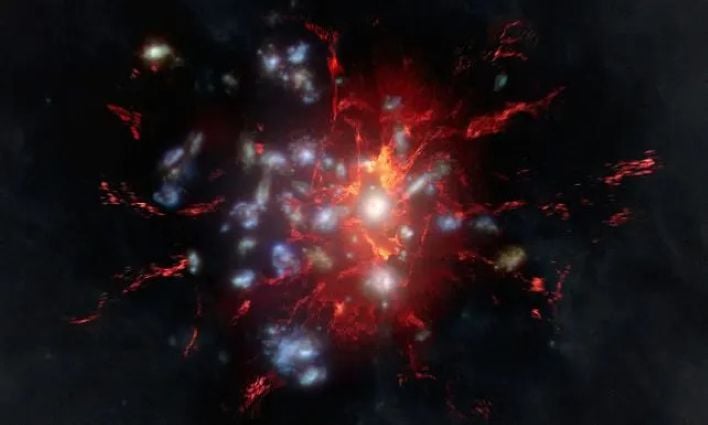
This infant cluster is not just hot, it's also quite chaotic. Its core spans roughly 500,000 light-years, but is packed with over 30 active galaxies. Furthermore, new stars are being churned out by these galaxies at a rate 5,000 times faster than our own galaxy. The scientists believe this frantic activity, combined with the presence of at least three supermassive black holes, could act like a pressure cooker. As these black holes feed, it's possible that they blast jets of energy into the surrounding gas, heating it far more rapidly than gravity ever could on its own.
In short, rather than a slow, orderly assembly, the universe’s largest structures may have undergone rapid bursts of energy injection that fundamentally altered their evolution. This discovery forces a rethink of the timeline for the early universe, suggesting that things like supermassive black holes were already exerting a dominant influence on their environments while the first galaxies were still in their infancy.
Main photo credit: Yuan Lingxiao





