



NASA's Webb Telescope Finds Record-Breaking Oldest Supernova Ever Recorded


The discovery originated with a signal known as a long-duration gamma-ray burst (GRB 250314A), first spotted by the Franco-Chinese Space Variable Objects Monitor (SVOM) satellite on March 14. GRBs, the most powerful explosions in the universe, are often the result of a massive star collapsing into a black hole or neutron star.
Subsequent observations by ground-based telescopes, including the European Southern Observatory’s Very Large Telescope in Chile, pinned the event to a redshift of 7.3, confirming its extreme antiquity—just 730 million years after the Big Bang. The previous record-holding supernova (also spotted by JWST) exploded 1.8 billion years after the Big Bang.
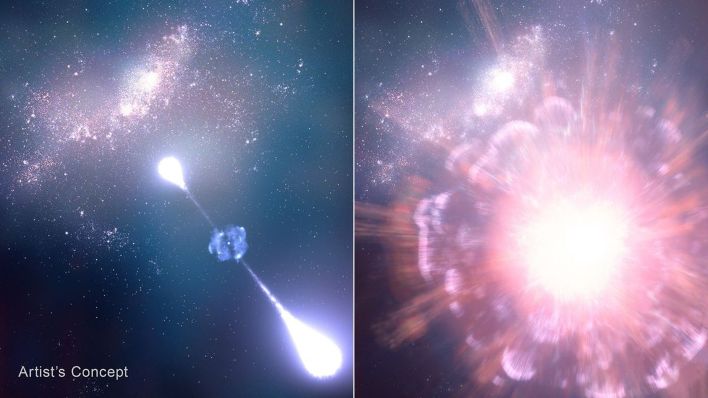
"Only Webb could directly show that this light is from a supernova—a collapsing massive star," Levan noted. Utilizing its Near-Infrared Camera (NIRCam), the telescope was able to isolated the faint, stretched light signature of the explosion.
Surprisingly, when the researchers analyzed the light from the record-breaking supernova, they found it to resemble modern supernovae in key ways. Up till now, stars from the early universe were theorized to be fundamentally different. i.e. more massive and containing far fewer heavy elements.
"We went in with open minds," said co-author Nial Tanvir of the University of Leicester. "And lo and behold, Webb showed that this supernova looks exactly like modern supernovae."
This similarity suggests that at least some massive stars during the Epoch of Reionization were much like their younger, modern counterparts. Furthermore, JWST was able to detect the faint, reddened smudge of the host galaxy itself, a tiny structure described as similar to other galaxies seen from that time.





