



Einstein Probe's Violent X-Ray Flash Points To A Black Hole Devouring A Dead Star


Follow-up from other telescopes around the world pinpointed the location of the event in the outskirts of a distant galaxy, and a drop in brightness of more than a hundred thousand times was charted over the course of about 20 days. The extreme nature of the phenomenon, officially dubbed EP250702a, could not be fully explained by existing models, which is what ultimately led to the conclusion of black hole activity. It occurring in the outskirts of a galaxy rather than its center was particularly unusual, and difficult to explain without a black hole being involved.
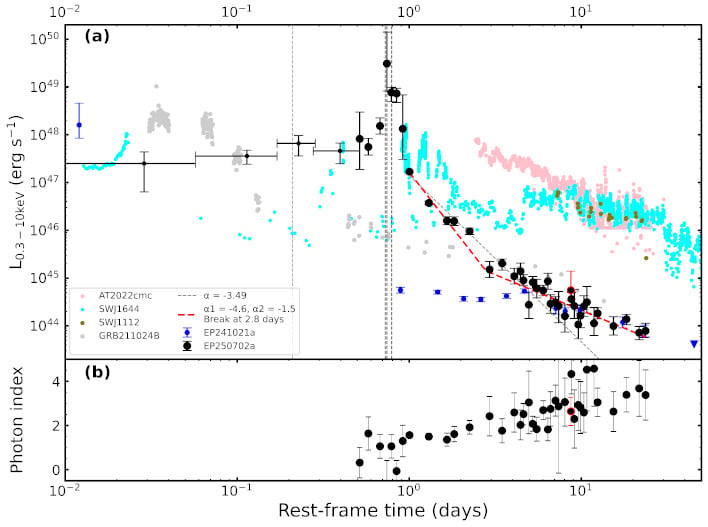
As the press release states, "If ultimately confirmed, this event would provide the first clear, direct evidence of an intermiedate-mass black hole tearing apart a white dwarf and producing a relativistic jet. Such a discovery would shed light on the long-missing population of intermediate-mass black holes and open new avenues for studying how black holes grow, the ultimate fate of compact stars, and the emerging field of multi-messenger astronomy."
To say the least, The University of Hong Kong has provided a fascinating look at the inner workings of our larger universe, suggesting that the density of white dwarfs eventually draw black holes to them to feed. Yesterday, those who live in Antarctica may have also witnessed a ring-of-fire solar eclipse (which gives this writer Elden Ring flashbacks, but that's beside the point), an event also viewed internationally via livestream. Alongside discoveries like an inside-out planetary system, these stories show that the stars above always have more for us to see as long as we're willing to look closely enough.
Image Credit: University of Hong Kong, Einstein Probe Science Center, National Astronomical Observatories, CAS




