



Ring-Of-Fire Solar Eclipse That Will Light Up The Sky Is Only Days Away


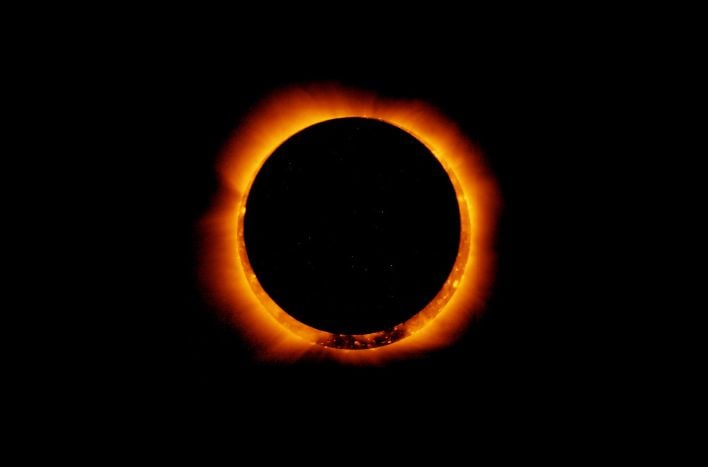
Otherwise known as an annular solar eclipse, the ring-of-fire eclipse occurs when the moon is at its apogee. Because the moon appears slightly smaller than usual in the sky, it won't completely blot out the sun’s outer edges. Instead, as it slides directly in front of the sun, it leaves a brilliant, blazing border of light visible, the eponymous ring of fire. For this particular event, the moon will cover approximately 96% of the sun's center, creating the annulus of light that will last for about 2 minutes and 20 seconds.
Unfortunately, the path of annularity where the perfect ring is visible is almost entirely confined to the frozen remoteness of Antarctica. Spanning roughly 383 miles (616 km) wide and stretching over 2,600 miles (4,200 km) long, the path cuts across western Antarctica and skims the Davis Sea coast. While millions of penguins will be treated to the eerie, midday twilight, the human audience will be limited to a few hundred researchers stationed at remote outposts like Concordia and Mirny Station.
As with any solar event, we must stress that looking directly at the sun without specialized protection is a big no-no. Even during an annular eclipse, when most of the sun is covered, the remaining sliver of light is intense enough to cause permanent eye damage. Certified ISO 12312-2 eclipse glasses or indirect viewing methods, like pinhole projectors, are essential for anyone wanting to witness the event safely.
This event will be the first of two solar eclipses occurring this year. The next one in August is going to be a total eclipse and will sweep across Greenland, Iceland, and Spain.





