



DJI Unveils Lito X1 and Lito 1 4K-Capable Drones Built for Beginners


DJI has lowered the barrier to entry for aerial cinematography with the launch of its new Lito lineup. Led by the flagship Lito X1 and the more accessible Lito 1, the duo focuses on extreme portability and simplified flight controls without sacrificing things like stabilized video quality and transmission range. Of course, U.S. shoppers will have to look elsewhere due to the ongoing government ban on the Chinese brand.

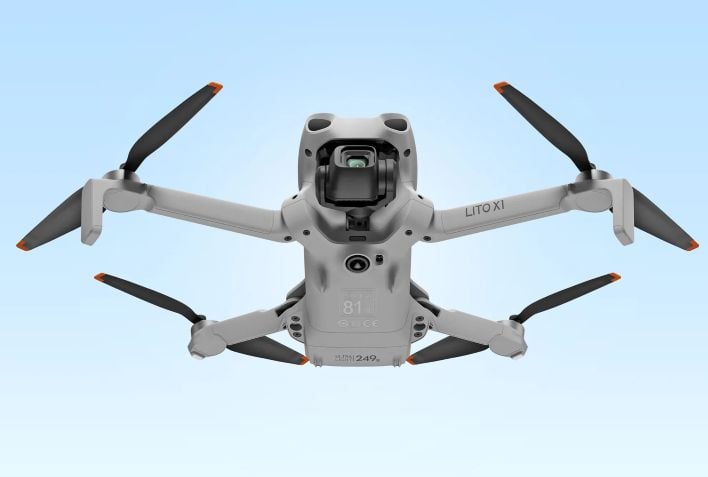
Like much of DJI's consumer/beginner-friendly quads, the Lito X1 comes in under the 249-gram threshold that requires FAA registration in many regions. Despite its size, the X1 features a 48MP 1/1.3-inch, f/1.7 CMOS sensor with up to 14 stops of dynamic range. In comparison, the Lito 1, at least in the imaging front, is more entry-level, offering a 2.7-inch CMOS and a three-axis gimbal that still provides smooth, social media-ready shots for those new to drone photography. Both models support 10-bit D-LogM, however.

Both models feature an omnidirectional vision system that actively scans for obstacles in every direction. The premium Lito X1 goes further by including forward-facing LiDAR, which helps the craft to maintain spatial awareness even in complex environments or low-light conditions where traditional optical sensors might struggle. Historically, DJI's LiDAR and general object tracking/avoidance performance (such as on the Air 3S) have been pretty spot on, demonstrating remarkable ability to brake or bypass branches and walls. This is obviously not going to solve beginner pilot errors, but is meant to greatly reduce that risk..
In the terms of flight time, the Lito 1 and X1 boast 36 minutes, but in real life, expect closer to 25-30 minutes. Certain markets also have access to the Intelligent Flight Battery Plus that can claims 52 minutes of endurance. The X1 offers 42GB of internal storage, whereas the Lito 1 ("little one," get it?) requires a microSD card.
Despite recent buyer preference for palm-launch quadcopters, it's interesting that DJI chose to launch the Lito series instead. Many new pilots (and well-meant gift-givers... thanks, Grandma!) are buying palm-launchers like the HoverAir series and even DJI's own Neo models, because they don't require remotes; they simply take off from the palm of your hand and perform a preset flight plan, complete with object tracking and avoidance.
Nonetheless, the DJI Lito 1 and X1 are now shipping for roughly $397 and $490, respectively, for the base set.





