



China's CXMT Starts LPDDR6 Mass Production Ahead Of Samsung & SK Hynix


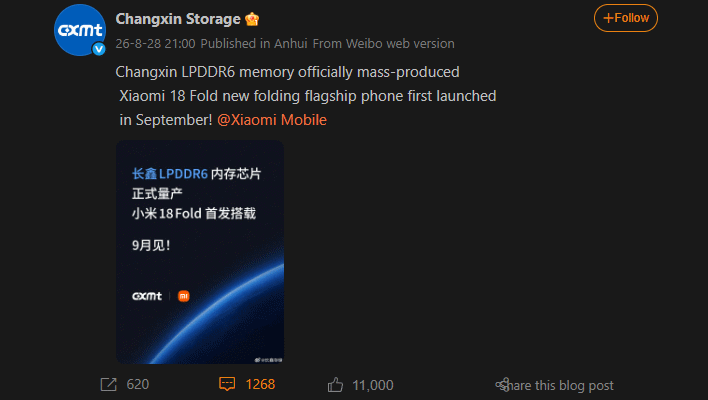
First, the announcement. Changxin posted a simple statement on its recently-launched Weibo on Friday, stating straightforwardly that LPDDR6 memory was in production and also that Xiaomi's 18 Fold, which is launching in September, will be the first device to use it. These are both pretty big announcements, as CXMT has beaten SK hynix, Samsung, and Micron, the three historical pillars of the DRAM cartel, to the punch with its latest RAM.
As we reported last week, Xiaomi puts down a memory transfer rate of 10,667 Mbps for the LPDDR6 interface. Combined with a 4× 24-bit bus width (96-bit total), that gives a peak theoretical memory bandwidth of around 113.8 Gbytes/second. Why not 128 GBytes/second? Because while LPDDR6 transfers 288 bits with every transaction, 32 bits are dedicated to metadata. That means you need to multiply your bandwidth numbers by 8/9 to find the actual peak bandwidth.
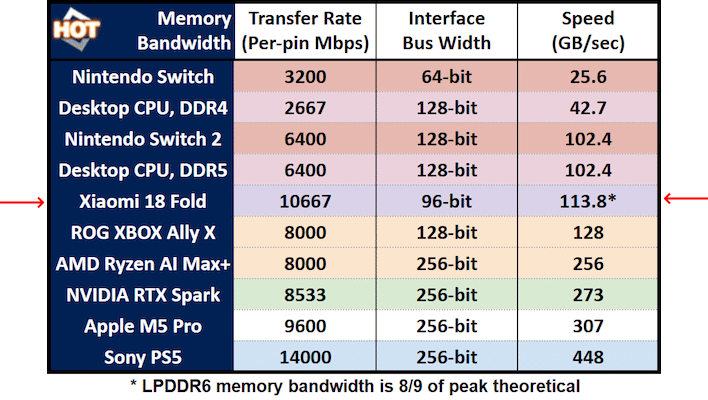
Still, 113.8 Gbytes/second is very high memory bandwidth. That's more than a desktop PC running dual-channel DDR5 memory at 6400 MT/s, and it's radically more than most smartphone SoCs, which to this point have generally maxed out with LPDDR5X memory on a 64-bit bus, meaning both a narrower data path and lower transfer rates. Xiaomi says that the XRING O3 SoC used in the 18 Fold offer 48% more memory bandwidth than the XRING O1. This is pure speculation on our part, but it's possible that the XRING O3 is using Innosilicon's LPDDR6 memory IP, which the company began offering early this year.
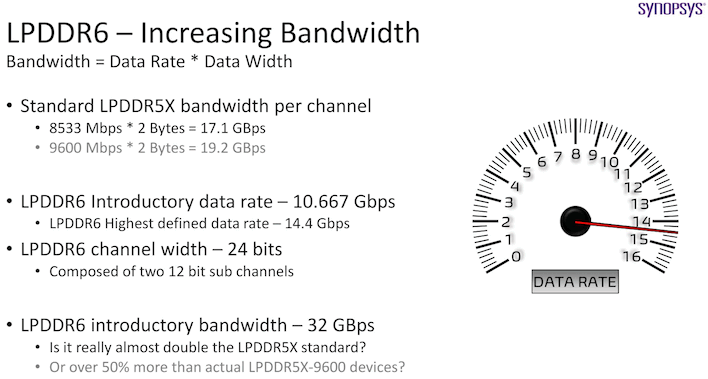
Notably, it's early days for LPDDR6, as 10.67 Gbps is actually the same transfer rate as the fastest LPDDR5X can achieve. With previous generational shifts in memory technology, the beginning of the new generation was always right around the top-end of the previous generation in terms of performance, but due to the wider memory bus available on DDR6 and LPDDR6, we're going to see some pretty significant bumps in memory bandwidth right out of the gate. The first-generation LPDDR6 is running at 10.67 Gbps, but the tech is already expected to scale to 14.4 Gbps and beyond.
As for those of us in the desktop DIY PC space, we'll be looking at DDR6 memory, as LPDDR6 won't offer the ultra-low latency we expect from desktop memory due to the trade-offs it necessarily makes. Unfortunately the DDR6 spec is still not finalized by JEDEC. It probably doesn't matter that much in any case, as AMD has promised to support the Socket AM5 platform (which only supports DDR5 memory) through 2029. Similarly, Intel's upcoming Nova Lake platform launching at the tail end of this year or the beginning of next year, and which is said to support as many as four generations of CPUs, is also slated to use DDR5. So saying, we'll be waiting another few years for the memory transition in desktops and even longer in servers.





