



Astronomers Capture Close-Up Images Of Exploding Stars In Stunning Detail


These new observations, published in Nature Astronomy last week, utilized a technique called interferometry at California's Center for High Angular Resolution Astronomy (CHARA) array. By combining light collected from multiple telescopes, astronomers achieved a resolution sharp enough to directly witness these unfolding cataclysms. Study co-author and Texas Tech University astrophysicist Elias Aydi likened the breakthrough to "going from a grainy black-and-white photo to high-definition video," providing visual evidence of the messy, multi-stage (and sometimes mysterious) nature of nova eruptions.
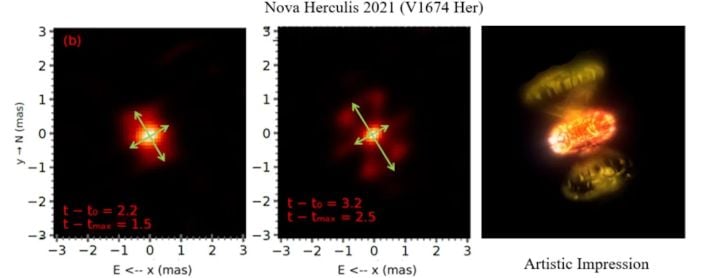
The second sample, Nova V1405 Cassiopeiae, was an equally surprising revelation. This nova evolved much slower, and, contrary to established models, the star appeared to hold onto its outer layers for more than 50 days before finally expelling them in a forceful rush. Like the rapid herculis, this slower explosion also triggered new shocks and produced gamma rays detected by the Fermi telescope.
No doubt, these implications challenge the long-held assumption that novae are simple, single-ejection events, pointing instead to a variety of complex ejection pathways. Perhaps this new data can help astronomers connect the dots between nuclear reactions on the star’s surface, geometry of the ejected material, and the powerful shock waves that generate high-energy radiation.
"Novae are more than fireworks in our galaxy—they are laboratories for extreme physics," explained Laura Chomiuk, a co-author from Michigan State University. The team believes that that their study will aid future high-resolution observations in answering profound questions about how stars live, die, and affect their environs.





