



Astonishing Dark Matter Discovery Reveals Hidden Secrets Of The Universe


According to Tomonori Totani, a professor at the University of Tokyo, whose analysis of fifteen years of observational data from NASA’s Fermi Gamma-ray Space Telescope points to an unexplained energy signature emanating from the heart of the Milky Way. Since its existence was first posited in the 1930s, the invisible scaffolding holding the cosmos together (a material that accounts for roughly 27% of the universe’s total mass-energy budget) has only ever been inferred through its gravitational effects, such as explaining why galaxies spin faster than their visible matter allows.
However, Totani’s work has revealed something tangible: a faint, halo-shaped excess of high-energy gamma rays surrounding the Milky Way’s core that cannot be easily explained away by conventional cosmic sources. Apparently this lingering glow is the spectral residue that remains after all known astrophysical backgrounds, from cosmic rays to distant point sources, have been modeled and subtracted from the telescope’s data.
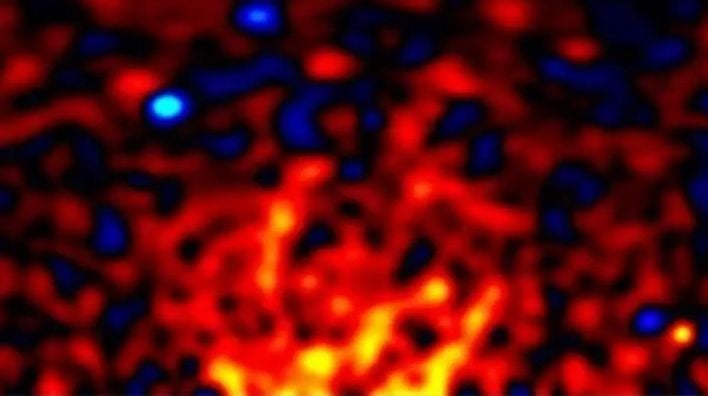
In his observations, the detected photons peak sharply at a specific energy of 20 gigaelectronvolts (GeV), and the spatial distribution of the emission is spherically symmetric, perfectly mirroring the theoretical structure of the dark matter halo that is believed to envelop our galaxy. This combination of spectral and morphological characteristics aligns with predictions made for the annihilation of Weakly Interacting Massive Particles, or WIMPs, i.e. the leading theoretical candidate for dark matter.
These hypothetical particles are predicted to be much heavier than protons (Totani’s findings suggest a mass approximately 500 times greater) and while they barely interact with normal matter, when two WIMPs collide, they destroy one another, releasing a burst of high-energy gamma rays, exactly like the 20-GeV signal observed.
"If this is correct, to the extent of my knowledge, it would mark the first time humanity has ‘seen’ dark matter. And it turns out that dark matter is a new particle not included in the current standard model of particle physics," Totani stated during the announcement.
Of course, in the cautious world of astrophysics, such an extraordinary claim demands extraordinary evidence, and Totani’s findings are currently being met with critical optimism and a healthy dose of skepticism from the broader scientific community. Researchers not involved in the study are quick to point out that the complex, dense environment of the galactic center is difficult to parse, and signals could potentially be mimicked by less exotic sources, such as unknown populations of neutron stars or millisecond pulsars. The difficulty lies in definitively ruling out every other possible astrophysical explanation.





