



Milky Way's Mysterious Glow Reveals A Dark Secret About Our Galaxy


New research from Johns Hopkins University and an international team of scientists suggests that two competing theories for the diffuse glow near the center of the Milky Way—colliding dark matter particles or rapidly spinning neutron stars—are, for the first time, equally viable.
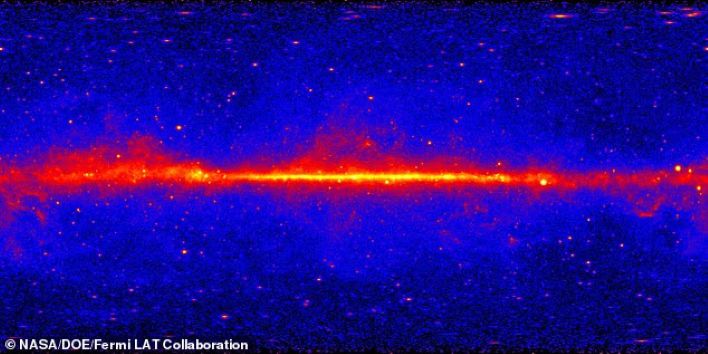
"Dark matter dominates the universe... it's extremely consequential and we're desperately thinking all the time of ideas as to how we could detect it,” said co-author Joseph Silk, a professor of physics and astronomy at Johns Hopkins. Silk adds, "Gamma rays, and specifically the excess light we're observing at the center of our galaxy, could be our first clue."
For years, astrophysicists have detected an unexplained excess of gamma rays emanating from the galactic center, an area thought to be rich in dark matter. Thus, to investigate the origin of this light, the research team used supercomputers to create sophisticated simulations. Crucially, the new models factored in the Milky Way's chaotic formation. Previous simulations treated the galaxy as a static, closed system. The new approach recognized that during its first billion years, the young Milky Way grew by absorbing numerous smaller, galaxy-like systems made of dark matter and other materials.
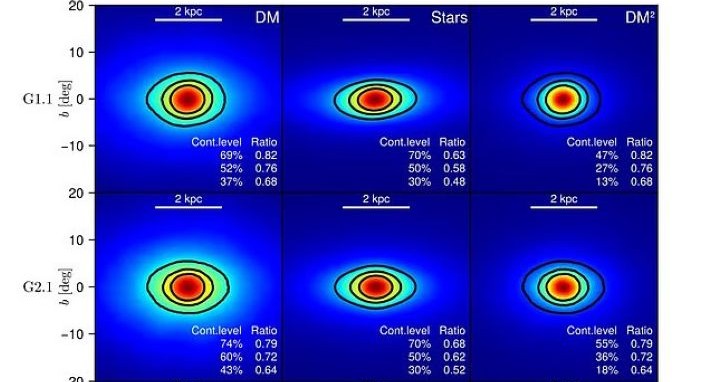
As these dark matter systems converged and clustered toward the galaxy’s core, the likelihood of dark matter particle collisions increased. According to theory, these annihilating or decaying dark matter particles would be the source of the gamma-ray light.
But what of the second main theory, as it remains equally persuasive? The competing explanation states that the gamma-ray excess comes from millisecond pulsars, i.e. ancient, rapidly spinning neutron stars. These dying stars emit light that could also explain the existing gamma-ray map and signal signature. However, researchers note the pulsar theory is mathematically "imperfect." To make the numbers work, the millisecond pulsar hypothesis requires scientists to assume the existence of a population of pulsars that is larger than what has actually been observed to date.
So the next step is to find a way to distinguish between them. The team believes the construction of a huge, next-generation observatory called the Cherenkov Telescope Array (CTA) might prove to be the tie-breaker.





