



AMD Ryzen 9 9950X3D2 With 192MB L3 Cache Spotted In Multiple Benchmarks


To back up a moment, we're going to assume that you're familiar with AMD's 3D V-Cache. If you're not, check out our past coverage. People have been hoping for a Ryzen 9 processor with V-Cache on both CCDs for some time despite the somewhat questionable merits of such a processor. In terms of consumer workloads, gaming is the only thing that really benefits from the extra cache, and a single-CCD configuration with one stack of 3D V-Cache is typically the best performer in that arena.
Still, having doubled-up V-Cache does mean that you can enjoy a full sixteen-core CPU without ever having to worry about whether your game is running on the "correct" CCD. With the extant Ryzen 9 7950X3D and Ryzen 9 9950X3D, only half of the cores benefit from the 3D V-Cache, and so it can happen that games end up on the "wrong" cores, drastically reducing performance. That wouldn't be an issue with this chip, and it may also provide real performance benefits in tasks like code compilation, database analysis, computational fluid dynamics, and finite element analysis.
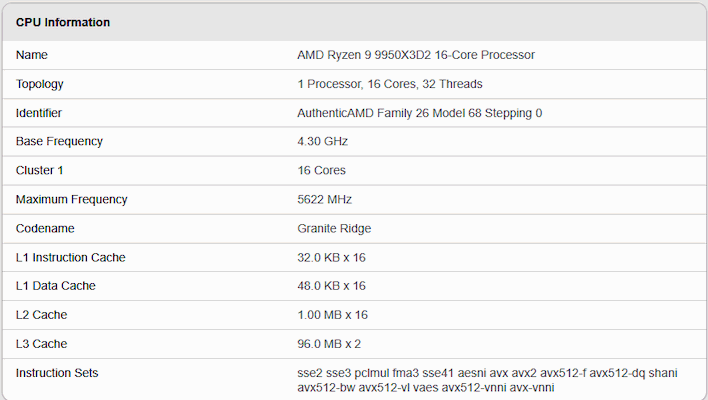
The leaks clearly come out of China, as the Geekbench result (at least), was run on a "Galaxy Microsystems" motherboard, better known as GALAX. Interestingly, GALAX hasn't actually released any motherboards based on the B850 chipset yet, so this is actually a motherboard leak, too. Nothing in the result is particularly surprising; the chip exactly matches the specifications that were leaked back in October by chi11eddog (@g01d3nm4ng0 on Xwitter.) Geekbench doesn't list TDP, but given that the rest of the specifications match up we wouldn't be surprised if this chip tops 200W for the first time since AMD's Centurion.
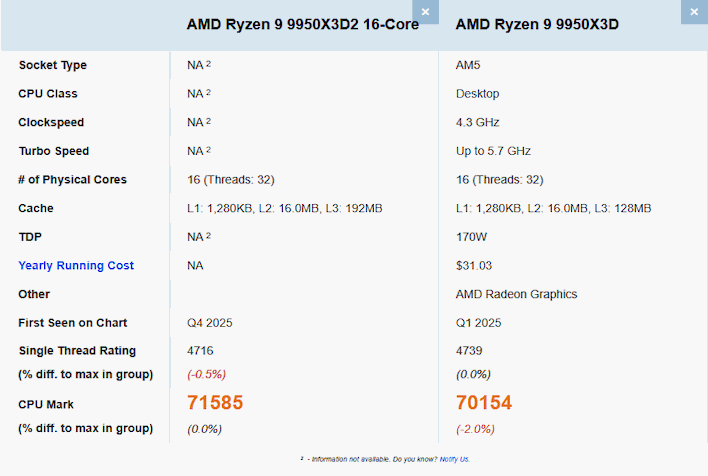
The Passmark result (hat tip @x86deadandback) is less informative, but it does confirm that the "X3D2" part doesn't seem to lose any performance versus the currently available part. The peak boost clock appears to be 100 MHz lower, at 5.6 GHz instead of 5.7 GHz, but the actual effect that has on the chip is a margin-of-error modification, and the Ryzen 9 9950X3D2 actually beats the older chip in multi-core, suggesting that the higher TDP is helping out there.
It will be fascinating to test this chip, even if we don't expect the results to be all that different for most users. It will be the sort of product where you need to find the use case, rather than the sort of thing that accelerates everything. For the few users who can really make use of such a chip, it will likely be a game-changer, but for everyone else, it's most likely going to be an expensive halo product for those with deep pockets.





