AMD ATI Radeon HD 5870: Unquestionably Number One


The GPU at the heart of the Radeon HD 5800 series has literally double the amount of processing power of the previous generation--up to 2.72 TeraFLOPS to be precise. As such, AMD has dubbed it their TeraScale2 GPU Architecture...

The GPU features 20 SIMD engines, each with 16 thread processors, that each have 5 stream cores, for a grand total of 1600. If you recall, the Radeon HD 4890 has a total of 800 processing cores. The Radeon HD 5800 series GPU also sports 80 texture units--4 per SIMD engine--and a GDDR memory interface that offers approximately 150+ GB/sec of peak bandwidth.
With a core clock speed of 850MHz, the Radeon HD 5800 series GPU offers 2.72 TeraFLOPS of single-precision processing power, or 544 GigaFLOPS double-precision. Its Texel fill rate (bilinear filtered) is 68 Gigatexels/sec, and its pixel fill rate is 27.2 Gigapixels/sec.

As the comparison chart above shows, the Radeon HD 5870 offers essentially double the performance of the Radeon HD 4870 in a number of key categories. But in addition to the increased processing resources and performance, the Radeon HD 5800 series GPU also offers many more features, like full DirectX 11 support, ATI Eyefinity, and updated video engine, and more.
;)
;)
;)
;)
;)
;)
;)
;)
;)
Radeon HD 5870 Reference Design
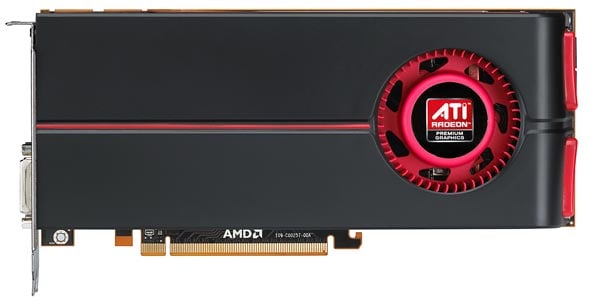
The Radeon HD 5870 card itself is 10.5" long and features a black fan shroud that encases the entire PCB. The card's cooler has a barrel fan that draws air into the shroud, where it is forced through the heatsink and partially exhausted from the system through vents in the card's mounting plate. Two more small vent at the back of the card also direct some air to be vented within the system. Overall, the cooling solution is much like the one used on the Radeon HD 4890--we cover more details on the power consumption page towards the end of the article.
The Radeon HD 5870 sports a GPU clock of 850MHz with a memory clock speed of 1.2 GHz (4.8Gbps effective)--that equates to roughly 153.6GB/sec of peak memory bandwidth. According to AMD, maximum board power is 188 Watts, up slightly from the previous generation, but idle board power is down to an impressive 27 Watts. The low idle power comes by way of aggressive clock gating and voltage reductions when the card is not under a significant workload. And as you can see, two 6-pin PCIe power connectors are required.
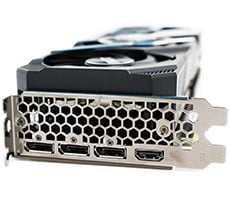
The outputs on the Radeon HD 5870 consist of dual, dual-link DVI output, and HDMI output (with audio) and a DisplayPort output. A future version of the card will feature 6 DisplayPort outputs--more on that on the Eyefinity page.
ATI Radeon HD 5850--Coming Soon
AMD is also announcing the Radeon HD 5850, which is very similar to the 5870 save for a smaller PCB, lower clocks, and fewer stream processing units (1440). We hope to take a look at Radeon HD 5850 in the not too distant future, and will of course fill you in on the pertinent details as soon as possible.