NVIDIA GeForce GTX 1650 Review: Budget Gaming On Turing

A couple of weeks back, NVIDIA launched the latest edition to its Turing-based GPU line-up, the GeForce GTX 1650. As its name suggests, the GeForce GTX 1650 is similar to the recently-released GeForce GTX 1660 and 1660 Ti, but it is powered by a different GPU with somewhat tamer specifications, which results in a lower price point as well. We’ll dig into the specifics in just a moment.
evga gtx 1650 box
As was the case with the GeForce GTX 1660 and 1660 Ti, there will be no Founder’s Edition version of the GeForce GTX 1650 arriving on store shelves. Instead, NVIDIA is relying on their add-in board partners to seed the market this time around. The card we’ll be looking at today is one the higher-end 1650s to be released, the EVGA GeForce GTX 1650 SC Ultra Black. As you’ll see, this card lands on the higher-end of the GeForce GTX 1650 scale, but it is still positioned as a mainstream GPU designed for gamers on a budget. Let’s take a closer look.

NVIDIA GeForce GTX 1650
Specifications & Features

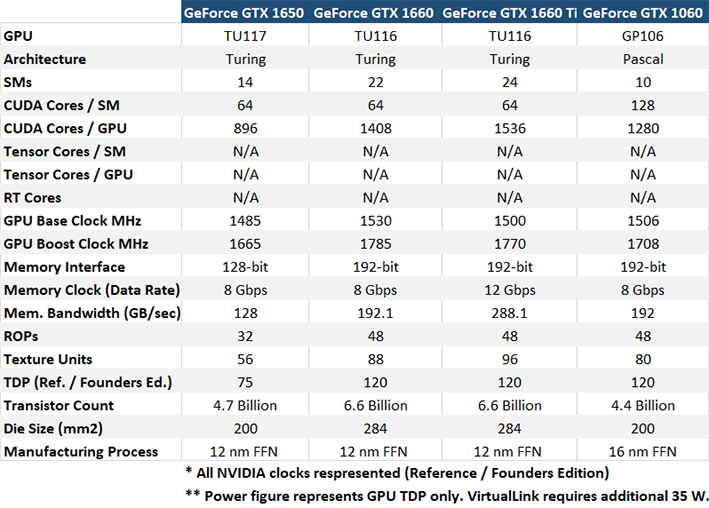
The GeForce GTX 1650 is based on a new GPU, NVIDIA's TU117, rather than a pared-down version of the TU116 at the heart of the GeForce GTX 1660/1660 Ti with a few blocks disabled. The TU117 is a smaller, 200mm2 chip, comprised of roughly 4.7B transistors. It’s packing a total 896 CUDA cores, arranged in 14 SMs (with 64 cores per SM). The TU 117 has 32 ROPs and 56 texture units, and it connects to its 4GB of GDDR5 memory over a 128-bit interface. NVIDIA’s reference specifications call for a base GPU clock of 1,485MHz with a boost clock of 1,665 MHz and memory with an effective data rate of 8Gbps, which results in peak memory bandwidth of 128GB/s. Board TDP (Thermal Design Power) is only 75W, which means there will be some GTX 1650 cards that don’t require any supplemental PCIe power connectors and can be completely powered by a PCI Express slot.
evga gtx 1650 1
evga gtx 1650 5
The EVGA GeForce GTX 1650 SC Ultra Black adheres to NVIDIA’s reference specifications, but is outfitted with a relatively large cooler and has a supplemental power feed to provide additional juice when overclocking. The PCB on the EVGA GeForce GTX 1650 SC Ultra Black is only 7.5” long, though the cooler extends past the PCB somewhat, so the total length of the card (including the bracket) is 8.5 inches.

Aesthetically, the EVGA GeForce GTX 1650 SC Ultra Black looks just like many of EVGA’s current-generation cards. It has a similar design language, with the webbed front fan shroud, and dual axial-fans with “E” logos scattered about all of the fan blades. This particular card is only 2 slots wide (not 2.5 slots) and features a relatively large and heavy cooler, with an anodized aluminum heatsink assembly, and a large copper heatpipe that extends over the GPU and back around atop the VRM. EVGA also outfits the card with a stylized back-plate, though we had an issue with ours. Two of the screws had actually come loose and were rattling around in the anti-static bag the card shipped in, so keep an eye out should you grab one of these puppies.
gtx 1650 outputs
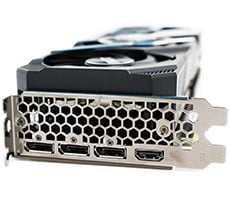
There is typical branding running along the top edge of the card, though there is no lighting on this model to speak of. The outputs on the EVGA GeForce GTX 1650 SC Ultra Black consist of a pair of full-sized DisplayPorts and a single HDMI port.

Marco Chiappetta

Marco Chiappetta

Marco's interest in computing and technology dates all the way back to his early childhood. Even before being exposed to the Commodore P.E.T. and later the Commodore 64 in the early ‘80s, he was interested in electricity and electronics, and he still has the modded AFX cars and shop-worn soldering irons to prove it. Once he got his hands on his own Commodore 64, however, computing became Marco's passion. Throughout his academic and professional lives, Marco has worked with virtually every major platform from the TRS-80 and Amiga, to today's high end, multi-core servers. Over the years, he has worked in many fields related to technology and computing, including system design, assembly and sales, professional quality assurance testing, and technical writing. In addition to being the Managing Editor here at HotHardware for close to 15 years, Marco is also a freelance writer whose work has been published in a number of PC and technology related print publications and he is a regular fixture on HotHardware’s own Two and a Half Geeks webcast. - Contact: marco(at)hothardware(dot)com

Related content