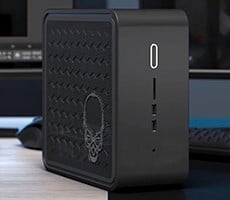
The motherboard in the NUC5i7RYH is a relatively small, highly-integrated board. It's kind of amazing how much is crammed into such a small PCB area, when you compare it to a full-sized desktop system.
There are ports at the front and rear and various slots and headers for expansion smattered about. In the image below, you cans see the dual SO-DIMM slots at the bottom and the M.2 slot at the top. There’s a spare USB header right about in the middle of the board, which can be used to enable additional functionality on the optional lids we mentioned on the previous page. The motherboard also had an additional SATA connector, which is connected to a cable that runs directly to the mounting plate to the right. To install a 2.5” drive, all you’ve got to do is slide it in and secure it in place with screws.

Cooling all of the hardware inside the system is a single large heatsink with integrated cooling fan. The fan pulls in air from the sides of the enclosure and exhausts it out the back. With some previous generation NUC systems, the cooling fans have been known to get a little loud. The fan in the lower-end NUC5i5RYK we took a look at remain relatively quiet, but to keep the faster GPU and more powerful Iris Graphics 6100 series core cool in this machine, the fan must move a significant amount of air and the rig can get a bit loud under load.
As we’ve mentioned, the NUC5i7RYH is a barebones kit, so you’ll have to vide your own RAM and drives, and install an operating system yourself. We tested the NUC5i7RYH with a dual-channel 16GB Crucial kit and a Samsung XP941 PCIe-based SSD capable of >1GB/s transfers.
When everything is installed and the NUC5i7RYH is ready to use, the first place you’ll likely visit is the system BIOS. The system is packing a very nice version of Intel’s Visual BIOS, which is easy to navigate and displays a host of system health data right on the welcome screen. The fan speed is listed, along with temperatures for the CPU, memory, motherboard, and PCH, and system voltages as well.